Showing posts with label Craft. Show all posts

Monday, August 22, 2011

C.J. Land

This week's topic is how do you put together the world your characters live in? I laughed when I read it. Why? Well, my whole life I've often questioned why things are the way they are in our world -- usually after hearing about recent government corruption or some grave injustice done to the little guy.

I'd often start off by saying "In C.J. Land…" or "If I ran the world…." much to my family's amusement.

Yes, yes, I'm admitting it here and now. I may not be the person to judge someone's worthiness to ascend heaven, but I have a very clear moral and ethical compass and most things are either "black or white" for me. Split second decisions, I go on gut and instinct. Doesn't mean I'm always right, but eh, I live with the fallout.

Drives my husband crazy, who is very much a "shades of gray" type of person. Which could very well be why we're such a good match. Never a dull moment as we debate the rights and wrongs of an important situation.

"That eight year old child spoke rudely to his neighbor, with arrogance and disdain dripping from his tone. His parents should be smacked for not raising him right."

Yes, that is the kind of pig-headed stubbornness you'll hear from me. And if I were to expound more on what is wrong with today's youth I'd probably get locked up, or you'd look at me like I was some angry ninety-year-old man yelling from his front porch. So, let me climb off my crazy soapbox and get back to the topic -- which is world-building.

For me, world-building is not hard. I throughly enjoy playing out scenes in my head where I'd walk up to the mother (whom I probably know) and politely lay out why her child is a raging brat or has the table manners of a three year old. But, since it wouldn't gain me any friends, I wisely keep my mouth shut. And trust me, some days that's very, very hard (especially since my house has been over run with kids this summer who have crappy table manners).

I grew up reading high fantasy novels. After reading The Hobbit in seventh or eighth grade, I was hooked. I especially enjoyed the glossaries found in most fantasy books. It would often help me understand all the aspects of the author's complex world. And if the Lord of the Rings was written today, I'd bet you a thousand bucks the publisher never would have let the names Sauron and Saruman both be used. We're watching the movies with the kids right now and the closeness of the two names drives me crazy.

For me, building my own world is the same thing -- creating a mental glossary of terms and characters. It may be in my head for most of the writing of the first book, but now, with book three being written, the terms are clearly laid out in the earlier books for easy reference for me as well as the reader.

Want to create a contradiction in your world? Easy-peasy. You're the creator. If a rule doesn't match what you've previously set up, think of an exception to the rule and how it might work. Sometimes, details are implied in your finished product, other times you may have to flat out explain it within the text through teaching or an interview scene between two characters.

How do you keep it all straight? Keep notes or start your glossary early. You may not use the long version in your published book, but it will ensure you make no glaring mistakes along the way.

What are some techniques you use in world-building? Please share, I'd love to hear!

~~*~~


~~ C.J. Ellisson ~~


Thursday, July 21, 2011

Meet Alien McGee

Most of my characters aren't aliens.

Many of my stories begin by imagining the character first. The world and everything else is then built around this person ... or alien. I usually see the opening scene, much like a movie, in my head. Then I have to figure out how to invent a whole novel or story around that character and scene.

I usually do some rough drafting before nailing down details. It's through that initial frenzy I learn more about my character. I can't tell him or her, she or he will tell me as the story and world unfold.

At that point, I'm ready to delve more deeply into a character. There are many ways to do this, and it's as individual as a fingerprint. I like to write sketches in a journal -- a brief bio of my character's life before the story begins, my character's foibles and habits, and I sketch out their arc -- how they change over the course of the story. I usually find a photo or piece of art to depict that character. Usually there's something in the piece of art that screams some trait I want to develop.

To get deeper into character, I decorate their personal spaces, fill their closets and jot down a lexicon so that I can paint the world through the character's senses. Every one of us has a unique lexicon. Writers have one. Every profession and region has one.

I also usually create a part for myself in the story, so I experience it beside my character. I tell myself the story over and over, seeing it like a movie. I tell myself the story every night before I go to sleep. It actually helps me fall asleep. At any rate, I go to sleep thinking of the character and story. When I wake up, I get to writing.

How do you get to know your characters?

Monday, July 18, 2011

Character Building Solutions


Today we're talking about how to get to know your characters. My characters are my best friends, I know everything about them. I firmly believe the more you know about your character, the easier it is to write from their point of view. That way you can drop your character into any situation and know exactly how they'd react. But the question is, how does one get to that level with their characters? Sure, you can character sketch, but that really only helps you shift through the physical stuff. You want to go deeper than that.

If you're like me, your characters talk to you. If this is the case, you should LISTEN and talk back. Yes, have a conversation with your character. Seriously. Try it. It's great. But sometimes characters don't talk. Maybe they're shy or just stubborn. Whatever the case, there are ways to get into their heads.

Bellow are six lessons/exercises to do with your character. You don't have to use any of this in your actual story, but boy does it help with those stubborn or underdeveloped characters!

(I copied and modified this from a workshop I took on Writing.com which was modified from the book "Characters and Viewpoint" by Orson Scott Card.)


Lesson 1: Character bio
Character Name:
1) Age:
2) Birthplace:
3) Marital Status:
4) Children and ages:
5) Living arrangements (i.e. lives with wife and three young children, rents a ramshackle apartment alone, has a tent in nomadic tribe with three concubines):
6) Occupation, including name of employer if applicable:
7) Degree of skill at occupation (beginner, really competent, experienced but a bumbler, etc)
8) Characters feeling about his occupation (loves it, hates it, regards it as “just a job”, has mixed feelings, is actively seeking other employment, etc)
9) Family background (whatever you think is important: ethnicity, siblings, parents, social status, clan affiliation, total repugnance toward everybody he knew before the age of twelve, etc)
10) What three or four things does this person value most in life? (i.e. Success, money, family, God, love, integrity, power, peace and quiet)
11) What three things does he fear most?
12) What is this person's basic underlying attitude about life? (i.e. "things will usually turn out all right," or "they're all out for themselves," or "it's best to expect nothing because then you won't be disappointed," etc.)
13) What does she need to know about another person in order to accept that other as "all right" and trustworthy?
14)What would cause this person more pain than anything else possible?
15) What would this person consider the most wonderful thing that could ever happen to him?
16)What three words would she use to describe herself, accurate or not?
17) How accurate is his self-description?
18) What organization most embodies this person's values? (i.e. Mensa, Daughters of the American Revolution her church, Aryan Pride, PTA, etc)
19) Does he belong to this group? Yes / No. If not, why not?

Lesson 2: The “Why”
Go back to questions 10-15 and answer WHY your character feels this way.

Lesson 3: Character Introduction
Pretend your character is introducing himself in front of a large group of strangers. What does he say?


Lesson 4: Stereotypes and assumptions
List 2-3 examples for each of the following:

1. A Character is what he does. You see a guy at the party who spills a drink, talks too loud, and makes rude remarks. You form a judgment. You tell a friend a secret, and in a few hours everyone seems to know it. You’ve learned something about your friend. Show your character stealing, the reader will think “thief”. This is the easiest form of characterization: have you character  DO something that demonstrates his nature.

2. Motive. This is more powerful than action – it trumps it. What if you knew that the drink spilling rude guy was trying to attract attention on purpose, in order to keep people from noticing someone else in the room. You impression of him changes. How about a character who tried to commit murder, but failed? You still think him a murderer even though he never actually succeeded in his task. Knowing why characters do what they do, reveals them to the reader. We will cover this A LOT later on, as well.

3. The Past. Knowing a person’s past, revises our view. You’re sitting at a dinner table, getting to know Pete. What if before hand, someone whispered to you that Pete was a POW for 7 years and escaped through enemy territory? Or that he just caused a corporate merger that resulted in thousand of workers losing their jobs? Does this effect your impression?

4. Reputation. This isn’t just for legends and heroes, this is for everyone. “Don’t bother asking Jeff to contribute, he’s such a tightwad I heard he would not even help buy flowers when Dona’s father died.” Same in fiction: you readers will likewise form opinions about characters they have not “met” yet based on what other characters say about them. Use it to your advantage.

5. Stereotypes. Paint half a picture, and you can count on your reader to fill in the other half. “The old man was wearing a suit that might have been classy ten years ago when it was new, when it was worn by someone with a body large enough to fill it. On this man it hung so long and loose that the pants bagged at the ankle and scuffed along the sidewalk, and the sleeves came down so low that his hands and the neck of his wine bottle were invisible.” Got the picture? This narrative relies on your stereotype to work. As a writer, you can use this one of two ways: either let the stereotype stand – sometimes very useful in creating minor characters who must not upstage the action … or, use it to surprise the reader.

What if the passage above was followed by:
“Hey, old man,” Pete said. “You’ve lost some weight.”
“It wasn’t the cancer, Peter, it was the cure,” he answered. “I’m glad you are here. Come upstairs and help me finish this Chablis.”
6. Network. We act different around our mother than we do around our coworkers than we do around our friends. So should our characters. Take your character out of one setting and put him in another, and see different aspects of their personality rise to the fore.

7. Habits and Patterns. She carries a Mace with her everywhere she goes. He always parks across the divide to take up two parking spaces, so his car does not get dented by the other car doors. Or just general habits, that clue us in to the character’s mind. He always taps his finger when he’s worried. After a while, the finger movement alone will clue us in to his mood.

8. Body. This one is tricky, because it is so easy to overuse it. Your reader will picture your character more through knowing her motives than through her looks (although knowing whether one is generally attractive or grotesque will influence this to a degree). So, does it matter what length fingers, color eyes, or size of breasts your character has? Maybe. It matters if it means something beyond mere fact. For example, in Lord of the Flies, Piggy’s poor eye sight (he wears glasses), his asthma, and his weight play a role in the story. His hair color does not.


Lesson 5: The Way I See It
Find a random image and write a short paragraph describing it as you would in your character’s POV.

Lesson 6: Emotional Stakes

1) Suffering. A character’s pain, whether emotional or physical, increases the reader’s emotional involvement. Note, however, that a character’s grief does not make the reader grieve any more than a character’s cut makes the reader bleed – it is the character’s reaction and feeling about their suffering that engage the reader. Intensity counts. Too little (a paper cut) won’t get you much bang for your buck. Too much (ghastly torture) and it becomes unbearable to the reader, so he distances himself. Frequency is also an issue. The first time a character gets hit on the head, we wince for her. The fourth time, we think of the Three Stooges.

2) Sacrifice. Pain and suffering also increase emotional stakes if the character has a choice in the matter. Nora setting Pete’s broken arm has less impact on the reader than Pete deciding to set it himself, making painful choices will each movement. This also works on the villainous side of things: Pete accidentally hits a child with his car vs. Pete does it on purpose. The reader may hate Pete for the latter, but the reader will care.


3) Jeopardy. This is the anticipation of pain… think of waiting to see the dentist. Put a character in a situation where great pain is upcoming, and you’ve got the reader’s attention.

4) Symbols. You can increase a character’s importance by connecting the character to the world around her, so that what happens to her seems to have a greater reach. As King Lear reaches madness, a storm breaks out. Oedipus’s sins cause a famine, which does not end until he pays the price.


Readers, what types of fictional characters draw you into a book? What's the one thing every hero/heroine needs in your opinion?

Monday, June 27, 2011

Multiple POVs, All Male, What's a Gal To Do?

This week we're talking about head hopping. Interestingly enough, this means two things in writing.

One, which is the most common for writers -- you are deliberately switching point of views (POV) to give the reader new insight into a character.

Two - you accidentally do it mid-scene when you reveal something or state an opinion that is outside of your POV, and is therefor a no-no.

I've done very little of the second because most all of my work has been in first person, which makes the accidents rather infrequent. I have been known to make a mistake with an assumptive phrase that was omniscient and the head I'm in could not know it, but for the most part my peers pick these slips up before it ever gets to the reading public.

I never set out to head-hop and write multiple POVs when I started writing urban fantasy. One of the things I love about the genre is the kick-ass female or male first-person POV. Primarily these stories are told from the same narrator's view the entire tale.

I thought mixing up the POVs would be fun and a great way for the readers to get to know the other characters in my series, and trust me, I did the big "no-no" and have a ton of characters! So many that there is a glossary of terms and characters in the book. But, I have to admit, I used to refer to those all the time when I was reading complex fantasy worlds, so adding one to my own work was always part of the plan.

The hardest part for me was doing male point of views -- and being consistent. I have five male and two female POVs in The Hunt, which is releasing this week. The female ones were a breeze, for obvious reasons... the male ones... well, I quizzed my husband a lot, my medical massage therapist who helps with my rheumatoid arthritis and various muscular issues, my friends (dads on my kids sports teams or in my neighborhood), read the status updates on all the twenty-something guys I'm connected to on Facebook through my nephews, and I eaves-dropped quite a bit.

Did I pull it off? The reader will ultimately be the one to decide, but I can tell you it was hard. The hardest thing I've ever done in writing, actually. Most people might think the hardest thing in my writing is present tense, but you get into the groove and once you master the flow you just get better over time.

What did I learn with all my fact finding?


  • Some guys swear a lot, some don't. A few reserve such vocabulary for times of stress. 
  • Not all men think with the dicks, but quite a few make comments and observations that appear as if they do. 
  • The young ones still care what their friends think (even though they like to think they don't), the older ones could give a rat's ass and seem more comfortable in their own skin. 
  • Some men have a tendency to "size up" other men when they meet them (can I take him in a fight), but the majority probably don't.
  • They love to laugh at each other (not with them, there is a difference) and will bust a rib laughing if one of their friends hurts themselves.
  • They speak in short sentences, for the most part
  • They are not overly flowery in descriptors or in compliments.


Men are a lot like women - each one an individual, but with a lot of the same underlying traits. How they speak and act is directly related to their recent environment exposure -- like a college student will act different than a military man of the same age. Yes, one person can be both at the same time, but you're missing my point.

Just like with all of us, our character's pasts reflect how they act in the here and now. In order to write multiple POVs in one story at the same time you must know how that person will react in the situation. I had one beta reader out of a dozen who told me only one of my male POVs sounded unique, and that the rest all sounded alike. But eleven said they loved reading the different POVs and getting to know the characters-- so I went with the majority.

Perfecting the initial chapters with the individual voices took me weeks. I keep going back over them again and again to make them each distinct. In the end, I know I won't please everyone with my work. Perhaps, this reader felt my style of writing lent to each person sounding similar, I'm not sure.

All I can say for sure is I really enjoyed the multiple POVs. Sure, it was hard as hell to plot out the book hopping from one head to the next, but in the end it flowed well -- like a baton being passed in a relay race -- the story moved from one person to the next, never replaying action over the same scene again.

Will I do it again? You betcha.

How about you - do you like to read multiple POVs in books or do you like to write them? Tell me how you master writing the opposite gender!

Monday, May 2, 2011

"She Sounds Like YOU"

My close friends were the first ones to read my work who knew me. Sure, I'd had faceless, good-meaning strangers help to polish my work and give me their thoughts. But, most of them didn't know I have long, copper red hair, a curvy physique, a strong personality, slip into bouts of micro-control when under stress, and love my husband with a deep, consuming passion.

Friends and family? They know me pretty darn well and saw right through Vivian's gruff exterior and laughed their asses off at me. Before I got sick, I took the lead on many parties, projects, meetings, groups... you name it. I never assumed I should be in the lead role, it was usually thrust upon me or thankfully handed over by my busy peers. I quickly built a reputation for getting things done, being organized, loyal, and someone you could always count on to follow through.

One friend loving called me a "sheep dog" saying I herded the children and adults in a very unnoticeable way at large parties or gatherings, making sure the event followed smoothly. I was paid in college to run parties professionally, taking the place of the hostess regarding mundane duties like timing the courses, ensuring the catering staff followed her directions, lining up all details of the event to run like a fine tuned machine.

It taught me a lot. The experience showed me how to lead without being bossy. How to encourage without giving a direct order or negative feedback. And when to realize butting heads with someone does not mean either one of you is right or wrong, you just clash and don't agree. Then, to maturely face the fact you probably never will and move on.

I've brought a lot of personal aspects of myself into Vivian because I never expected the book to make it. I've said before that I started this whole career as a distraction, a way to occupy myself from my day to day predicament of doctor visits and health problems.

I've read in several places Laurell K Hamilton wishes she hadn't made her popular main character, Anita Blake, look like herself. I always found that kind of funny. It's done, so move on. No need to worry about what you can't change.

I feel that way about Vivian. I hadn't intended to pour so much of myself into her. I did intend to make her a powerful, ruthless woman with control issues, and one who may not win friends because of her actions. I wanted her fair, logical, passionate, and slightly paranoid. She is kind of like me on small things, but more of her own as the story evolves-- and thankfully my friends agreed, saying they quickly forgot the comparison and were able to enjoy the story.

In real life, I don't say all the snarky stuff Vivian does, I just dream about it. I don't hang from the basement rafters and have gymnastic-like sex. There has never been a time in my life where I have been chained to a wall and spanked with a crop -- and I can promise there never will be.

And, as much as I wish, I don't have the relationship she has with her spouse. I'm blessed with a good marriage to a man I admire and love. A man who is also my best friend -- but he is not Rafe by any stretch of the imagination.

As writers we're told to "write what you know". We need to make realistic characters and for new writers, like me, that means drawing on yourself and those closest to you. I've grown in my writing abilities and have been able to make up main characters nothing like me.

My erotica novellas require a different type of experience level ;-), and I can weave those elements in with completely unknown characterizations. That's where having a great imagination comes into play.

Sure, most of us may incorporate bits of ourselves into the stories we create. But isn't that what helps the story come to life? What do you think? Have you written about someone who looks, talks or acts like you?

**CONTEST TIME**

I'm running a unique pre-launch promo contest. I plan to give away ten signed and numbered copies of The Hunt (numbers 3-12, 'cause I'm giving my brother the first two). They will be mailed to winners one week prior to the book going up for sale, which is slotted right now for June 30th, 2011.

Here is how you enter: You comment on any blog I do for the next six weeks. I will notify readers when I post on my Facebook business page, and I will Tweet about it. Each comment counts as one entry (only one entry per post, but you can comment more if you'd like). The comments must be made within the first 48 hours of the post going live, and I will post a "closing" comment when the entries for that day are closed.

All entries will be tossed into a drawing, and the participants with more entries have a higher chance of winning.

BONUS!! Every entrant who comments on at least six blog posts and does not win a signed print copy will receive a free ecopy when the book goes up for sale.


Let the games begin!!

Monday, February 21, 2011

Group, Partner, or Solo?

Sounds like a sexual reference, but I swear, this time my mind is clean ;-) This week we're discussing critique groups and do they work for you. My answer is pretty muddled: Yes and No.

In the beginning, when I first started writing, just two short years ago, I thought they were great. Lots of opinions, lots of insights. It quickly became overwhelming. The negative stood out to plague me and I had to sift through the crap to find useful advice.

My first attempt was with two online resources - writing.com (WDC) and the critique circle (CC). The former had people who really reviewed (which is how I met and became friends with Greg), a few were more like advanced beta readers, and TONS more trolled for gift points on the WDC system and left me one paragraph of nonsensical gibberish as a review.

CC, on the other hand, gave very in depth reviews, but moved achingly slow and following their guidelines I'd be shifting my novel through their system for six months or more. Some of the critiques I got on that site just about crushed me. I had published erotica writers slamming my present tense, my style, my voice -- pretty much hating everything I wrote, until they got to the sex parts. (I had to join their group b/c site guidelines regarding the sex scenes in Vampire Vacation)

Once they read the sexy parts, they grudgingly admitted I could write. And I'll go out on a limb here and suggest that it's they held such opinions possibly because they don't have sex (judging by most of their pics I'd say the last thing they chased was a donut), they just write about it, and so reading a piece from someone who actually has sex blew them away.

Nasty bitch today, C.J.? 

No, not really. Reading a woman write male on male erotica involving anal sex when she's never had it is very obvious. And they said some nasty shit to me about my work, so I'm glad I bailed on the site.

Next, I tried forming a paranormal writing critique group on yahoo. It worked out well and I met some great ladies I still keep in touch with, but again it moved slow. By this point in my illustriously short writing career (about two months in), I joined Romance Writers of America (RWA) and immediately joined a slew of specialized sub chapters.

I have to admit, hands down, the best writers I've met to date are associated with RWA. Professional, hardworking, honest and thick skinned. The best ones focus on the work and never let emotion or arrogance come into play. That's not to say I didn't meet some cruel judges in contests who enjoyed hiding behind their anonymity to bash my attempts, or some lazy bitches who would spend fifteen minutes critiquing a piece of my work when I spent 90 minutes on theirs (hello - did you not notice the time stamps in your track changes?). Overall though, joining those chapters opened up a world of possibilities for me.

But again, these groups moved too slow. I was focused on my craft 40 plus hours a week and needed a partner who was better than me. Sure, at month two that was easy to find, but by month four I needed a real editor. Not someone telling me their opinion on my characters and my plot - but someone helping me to hone my craft.

I hooked up with a writing partner who taught me more than any other person in the industry to date. We worked exclusively together for about nine months and I was so sad to see the relationship end. While she struggled with plot holes and content in her manuscript, I learned the art of line edits and got a better grasp on punctuation. She taught me some of what twenty years in the industry as a journalist and editor had taught her.

This woman single handedly whipped my writing into shape and made me the writer I am today. Without her, I'm not sure where I would be today. Things, unfortunately, came to an end, I'll spare you the drama, but we are at least civil and supportive of each other when we speak online.

This past summer, I tried to crit with Jen and Ana, both strong writers with different skills to bring to a critique. It didn't work out because of a new venture I launched, Everything Erotic, which has become a huge time commitment. I stretched myself too thin and something had to give -- and with all the editing I was doing for the team I couldn't take on more.

Thankfully, those writers have returned the favor in spades. Anytime I ask for a read I'm so touched I have three or four ladies jump in without a moments hesitation. One or two often tease they have to read my work two to four times to spot any mistakes because they get so pulled into the story they forget to be critiquing it. I can't tell you how amazing that is to hear after the months and months of crap I used to have spewed at me via the internet.

In eighteen short months, I found a home. A home among the writers I associate with on various group blogs and online forums. They tell me their thoughts straight, but politely.  They often remind me to slow down, stop working, rest, focus on getting better... and they share their amazement at how much I can do while being so ill. They cheer me on and give me the highest compliment a writer could ever receive: they tell me inspire them.

Sure, the convenience of the internet has made the publication and small successes I've achieved a reality, but it also provides a mask for some people to hide behind and spew their anger and hate to the world. I'm incredibly grateful that on my comparably short writing journey I've met such talented people who are proud to associate with me.

Thanks to each and every one of you. And you know, beyond a shadow of a doubt, I'd do anything in my power to help you and your career at the drop of a hat. After all, that's what friends do for each other.

Monday, January 24, 2011

"Flash What?"


Why, Flash Fiction of course! I never heard of flash fiction when I started writing, but hey, let's face the simple cold hard truth: There are books filled with stuff I didn't know about writing when I started (and there still are).

I've read in multiple places a writer should have some short stories and flash fiction publishing credits under their belt before they can expect to get a full novel picked up. There are so many examples of this not being the case I'm not even going to list more than one: Stephanie Meyer

'Nuff said.

While I do enjoy writing flash pieces, I can say it's not something I do regularly or with any real expertise. Wendy Howard challenged us last year to do a 50-word flash-fiction piece and I spent about 20-30 minutes trying to work through one. It was fun, got my creative juices flowing early in the day, and like most of my work the first year, focused on the main character I've been writing about for so long:

Lush and skillful, the enforcer kills with no remorse. Always drawn to death's sweet embrace, she delivers yet another into its suffocating hold. Her sword bites deep, a whisper of sound escapes, and silence prevails. She bends to drink. No undead who preys on children can hide from Vivian's wrath.

Clear, short, and meaningful. I felt a sense of accomplishment when I posted it and no one laughed. Now, let's pick it apart and have some fun!

What do we know of this person in so few words? 

It's a woman, who kills easily. She has a dark side within and she uses a sword... hmmm... we go on to see she drinks blood - Oh! We have a vamp ;-) Lastly... her purpose: to right the wrong of vampire pedophiles continuing in their heinous acts. 

I thought it was cool, but hey, I wrote it.

How about you? I challenge you to a 50 word flash fiction piece. You game? Leave it here in the comments, I promise there will be no laughing. Unless your name is Greg, then all bets are off. :-D

Tuesday, January 11, 2011

Website Attraction: Love Or Bust At First Sight

Honestly, I have not been able to pinpoint why I am attracted to certain websites and not others. I get recommendations to try different websites, especially those within my fields of interest – writing, science fiction, triple…eh, I mean mature entertainment.

I don’t go with most of them because they fail to catch my interest. Sorry, but at my age (43), MILFs has an entirely different meaning (and, no, I’m not going to show it -- a year ago, I might have, but I think I've finally given in to the invisible daggers coming from C.J., Ana and J.D.).

At the same time, intros to websites by well-meaning writers from New Jersey often get the precursory look (just to be civil) and then, bam, I block the site. Psst: Don’t tell the New Jerseyite I said that.

If I had to sit down and figure out some do’s and don’ts for website attraction, I’d sit down and figure them out. Well, actually, I am sitting down and figuring. Go figure.

Life does imitate art.

Anyway, a fellow Wicked Writer mentioned that she does not like to hear music on a website, such as the personal profile pages of MySpace. I agree with her, although I do have music on my page. The music reflects my tastes, but often leaves bad taste in the mouths of others. I guess a profile list of ICP, Annie Lennox, Norah Jones, Lena Horne, Sarah Vaughn, Ol’ Dirty Bastard, Jaheim, Poor Righteous Teachers, John Carpenter, Doris Day, Jane Monheit, Sade and Jana Mashonee can be confusing for anyone trying to figure out my mental state.

Personally, I think you should either pick some neutral songs that will appeal to a wide audience or stick with one genre. That way your visitors won’t be jarred senseless when Into the West is suddenly followed by Hokus Pokus and then by Kristy McNichol.


Hint: I like my music the way I like my women – ................................hmm, don’t know where I’m going with this.

Where was I?

Secondly, the site has got to catch my interest almost instantly. Perhaps this reflects my journalism background where a story has to grab readers’ attention spans within the first two or three paragraphs. This is why many of my posts begin with some form of humor – not particularly funny, but light-hearted.

Third, the site has got to not overwhelm me. You know what I’m talking about. Those FB and MySpace profiles filled with so much art and background that you can’t see the words. Apparently, there are pros out there who will jazz up your web pages to catch attention. I would not go for it because they seem to throw everything in there. Even KISS would say it’s too much.

Trying to imagine what the page looked like before it got all tricked up is like comparing Lady GaGa with Stefani Joanne Angelina Germanotta. 


Finally, the website must be finished. I know this from experience as I tried to set up my own author page and even put the address on business cards. I no longer hand out those cards (fortunately, it was because the card company misspelled “Smith”).

But, how many times have you been directed to a website that said “Under Construction – Be Back Real Soon”?

Reminds me of the Luby’s Cafeteria just off Northeast Loop 820 and Beach Street in Fort Worth. There was a sign in a vacant lot that said “ Luby’s Coming Soon.” The sign was there for four years before any construction began and another year during construction. The IHOP on the other side of the freeway did gangbuster business with people frustrated by the delay.
To make a long story short (too late), in order to get my interest at a website:
1)      Either kill the music or go with something akin to Muzak

2)     Get my attention quick. Use humor, interesting pictures (like a guy being beaten to death with his own arms), etc.

3)     Don’t overwhelm me with useless crap, and

4)     Make sure the site is finished before advertising it

Oh, I forgot one thing:

Please, oh please, stop putting your kids on your website. They may be the cutest kids in the world, but, although I have no interest in them, there are those online who do. I keep dreading that “ripped from the headlines” storyline appearing on Law & Order: SVU.

Now on to reconstructing my author page so I can make up new business cards.

Tuesday, November 16, 2010

Giving Some Thanks -- the Write Way

As I sit here at the computer, still digesting that fantastic meal from Golden Corral, I found myself reflecting on the topic of being thankful.

Now, this isn’t because it’s almost Thanksgiving, but more about why I was digesting the “wonderful” meal from Golden Corral. See, it was Military Appreciation Day and good old GC was treating veterans to a free meal (in case you’ve never heard of Golden Corral, it’s a buffet-style restaurant; a meal is whatever number of trips through the buffet line your stomach can handle).

Last Thursday was Veterans Day and a bunch of restaurants treated vets to an array of freebies, ranging from a free appetizer (like the Bloomin’ Onion at Outback Steakhouse) to an entire menu (Applebee’s). I can only imagine what would happen if Hooters joined the movement.

Being solo on these jaunts, I ended up sharing tables with others and got to hear their “war” stories and military tales. It made me wonder about these future generations are going to cope. I could remember all the discipline that military life had introduced into the lives of us veterans.

It made us productive citizens (most of us, anyway). The kind who built this great nation, brick by brick, girder by girder and X chromosome by Y chromosome.

Alas, it seemed as if the veterans’ appreciation is destined to become like Christmas – that once-a-year event where we all suddenly remember to be good to our fellow human beings, though even that is disappearing fast in an age of disaffectedness and political correctness.

For all the wonderful bits of technology we have available to us – cell phones, iPhones, Internet, laptops – we still seem not to know that there are wars going on. The news is reduced to “NATO servicemembers killed” yada yada yada.

Unfortunately, we’ve been going down that road for awhile. In Vietnam, protesters spit on returning veterans. While I’m glad no one is spitting now, we’re doing something almost as bad – we are gleefully and naively asking young men and women “did you kill anyone over there” or, even worse “how did it feel?”

Talk about disrespect. And everyone is asking, from little kids to adults.

I don’t know anymore.

As for what this topic has to do with writing, such a culture change appears in our books. Black Hawk Down: A Story of Modern War (Mark Bowden), The Hurt Locker(Mark Boal) and Anthony Swofford’s Jarhead have showed us a war fought by the brave while the disaffected back home don’t seem to   notice. Boal appears here again with “Death  and Dishonor,” a piece that led to the movie In the Valley of Elah, a movie based on actual events in which soldiers suffering from PTSD because of Iraq kill and dismember one of their own.

Maybe we should either start writing about the bravery of our men and women in uniform and stop focusing on all the negative stuff. Soldiers, sailors, airmen, Marines and Coast Guardsmen didn’t ask to go to war, but they performed their duties nonetheless. They certainly don’t need the people they’re safeguarding to paint them all with the same brush.

And maybe we can help with a few strokes of a pen instead of a paint brush.

At the very least, don’t wait until Memorial Day and Veteran’s Day to say thanks to those who served our country faithfully and with honor.

Thursday, November 4, 2010

Research: the write stuff – a tale of big words?

OK, a free blog topic! So, is it really true? I really don’t have to write more about horror, Halloween, and other ghouly stuff? (At least not for another year!)

But I have gotten so used to this place… writing about stuff I haven’t really a clue about! What am I to do now? Go back to mundane thrillers and financial crime? And, me being so late with this post… What will you readers be looking for now?
If in doubt… write from experience! Write what you know and can feel!

Yes, all well and good, I say… but there is an existential paradox here (big words #1 & #2) Oooo! I love it when I get philosophical! (Big word #3) Again I digress…

The Existential Paradox of Fiction


[caption id="attachment_3794" align="alignright" width="144" caption="A paradox..."][/caption]

Write what you know and can feel? But I write fiction. Fiction is not real. I cannot KNOW it; neither can I actually FEEL it! I cannot therefore write fiction based on what I know and feel. I cannot write what I cannot know. QED!

Existentially, if in doubt… what the h*** do I do now? How can I effectively write fiction if writing is best based on knowledge and experience and I have neither?

Research, I hear you say. (Well I might, if I could get the hang of this auto-suggestion malarkey!)

Research is a search for knowledge – perhaps the knowledge I need to write the fiction I am planning. But research implies a systematic investigation to establish facts and it usually also implies a scientific (not existential) method. What good is research to me? I am trying to write about stuff that does not exist – it is FICTION!
I repeat: F I C T I O N ! ! !

What about applied research, though? Surely that is different?

Oh, yes! Discovery and interpretation – all designed to advance human knowledge. But, knowledge as the basis of the unreal – of fiction? The paradox again. There are no facts concerning what is not real.

Now here’s one! Artistic research… Debatable! Art as an alternative in the search for knowledge and truth? Dubious, surely… but we are still digressing from the paradox! There are no facts concerning what is not real.

The existential paradox suggests: “why should we bother to develop our individual knowledge-bases as an aid to writing fiction – developing untrue narratives for the purpose of entertainment, not the advancement of human knowledge – why?
Why bother with research? We can just make stuff up, surely!

[caption id="attachment_3791" align="alignright" width="114" caption="A tricky place..."][/caption]

Case in point! A short time ago, I posted the opening chapter of my work in progress – the sequel to River of Judgement – in which I set the villain of the peace in a tricky situation in Libya. What do I know of Libya, or what an encounter with a criminal master-mind would be like? I know nothing. It’s fiction. I just made it up!

I created a social situation in a country that I have never visited, in a world (of crime) that I have never witnessed, about people that are wholly fictitious! If I was to gather facts – research, if you like – to develop the knowledge to write that scene on the basis of what I knew to be the case, I could end up in a pretty dicey situation myself. That is, assuming that such a reality actually existed somewhere, and didn’t mind being exposed in a real narrative. But then, that would not be fiction… ;)

I have missed a point here (deliberately so, in the hope that I could find enough to write about, lol)
The paradox of the unreal real is simply solved.

The answer lies in counterfactual analysis (big word #4). Assume the fiction is real, as we write about it. We research for facts that would support our fictional reality (if it was real). We research to support the narrative, not to provide it.

We want our readers to believe in the worlds we create. But the great thing is, these worlds we create don’t actually have to BE real. The world of our fictional narrative merely has to give the impression of a reality, long enough to engage our readers.

Fictional worlds, the places and characters that exist within them and the lives and actions we portray as fiction writers, form what can be described as socio-cultural contexts of systems of meaning, action, and/or beliefs.

These contexts of systems are basic to the world they describe. They are “plausibility structures”, and are a dialectic (given up counting big words now). Our fictional world should comprise a plausible structure, one that supports the fictional narrative. It does not replace it. And the fictional narrative, drawing on the plausible structure, in turn, suggests that structure is wholly real! The narrative acts to make the fictional world self-evident.

So research becomes a necessity if we do not have the knowledge to create and write about plausible structures.

And where does that leave the opening of my sequel set in Libya? Is my reality plausible? (Not factual.) Well, lucky me, this weekend I am about to set foot on Libyan soil for the first time in my life. I shall take full advantage of gaining experiences that will help me develop the structure of my fictional world – but I shall not worry a jot about the narrative! :)

Tuesday, October 5, 2010

Horror You Can Sink Your Teeth Into

Can’t you feel the tension creeping into your very soul?

Just an innocent walk home after a long day of work and suddenly a hand comes out of nowhere, grips you by the throat and hurls you into oblivion. Soon you’ll feel the fangs in  your throat and the very life sucked out of you.

Or maybe you’re not at work. Maybe you’re enjoying the beach. Casually splashing about as you paddle around offshore on your inflatable raft. How can you possibly know that a killer is lurking beneath the surface, gliding silently, purposefully, ignoring all the other swimmers just to zero in on you?

How about some hill climbing? The villagers are desperate to show you the view from the top. How are you to know that a prehistoric creature, awakened by Man’s foolish atomic experiments, will stick its head over that hilltop and issue filmdom’s most frightening and memorable roar? You don’t care as you’ll be fleeing in abject horror from a creature that will soon turn thousands of your fellow countrymen – innocent men, women and children – into funeral pyres.

Might as well seek the peacefulness of the country. Nothing can go wrong there, right, not like in those big cities? Hmm, sure are a lot of cats and dogs missing. Should I leave my window open tonight? What’s the worst that could happen? Maybe an eight-legged neighbor and about a million of his closest friends will drop in?

Hello and welcome to the world of my nightmares, better known as the horror movies that inspired and influenced me.

If you haven’t guessed, I am talking about The Night Stalker, Jaws, Kingdom of the Spiders and Godzilla.

These films were highly influential on me as a kid and even as an adult. Each one had a different effect on me, effects that I now find myself using a lot in my horror and science fiction.

I remember not going into the water for a long time after seeing Jaws in 1975. An intelligent shark? Who would’ve thought it? I mean, getting Chrissy Watkins for swimming nude at night was one thing, but ignoring allthose people at the beach to zero in on the kid on the raft? Well, that did it for me. If I was really brave, I’d go out waist deep at Revere Beach or Cape Cod, and I had trouble getting close to the gunwales of the ferries on school field trips to Nantucket (where they really filmed Jaws).

Now, you’ll find me using that silent, creeping-up style of terror in my short stories like the prologue to Red Herring that I told everybody not to read right before bed. Are those cockroaches on your legs or just the wind caressing your hairs?

The Night Stalker was the highest-rated TV movie of the time when it aired in 1972. Of course, I was only 5 when it aired originally, so I didn’t see it for a few years. And then when I did see it, it was on late at night. Right before bed. Good timing, eh?

Darren McGavin’s stark, matter-of-fact narration and the vampire's running battles with the police certainly didn’t look like Bela Lugosi or Christopher Lee’s Dracula.

Somehow, I think McGavin’s Carl Kolchak might have inspired me to become a journalist. I didn’t cover the weird, the supernatural or the horrible (no, I left that to the guys covering the Cubs) but I had the writing bug nonetheless.

Now, Kingdom of the Spiders could have fallen flat because of the hammy  William Shatner as the lead guy Rack Hanson. But, director Bud Cardos was

[caption id="attachment_3560" align="alignleft" width="300" caption="No beaming out of "Kingdom of the Spiders""][/caption]

able to overcome that with some tight direction, good camera work and  about 10,000 real tarantulas. Yes, folks, those actors and extras really were  covered with live tarantulas!

One particular scene that creeped me out was when the sheriff (played by the Marlboro Man) has to tell Altovise Davis that her husband, played by Woody Strode, has been killed by the tarantulas. As the scene unfolds, a tarantula sits on a fence, watching it. When she hears the news and bursts into tears, the spider slowly crawls away as if it had been waiting to see if the handiwork of its companions had the intended effect.

From that movie, I got the idea to use nature against Man and to do it in a way that could not be solved at the last second by the military or by some hastily-created weapon. William Shatner couldn’t overcome the tarantulas (and actually had to be rescued by Tiffany Bolling), so why should my characters in Crawl be one-man armies? That relentless wave of eight-legged horror (especially the scene where they’re leaping at the shoes of the little girl on the swing) was light years better than the CGI in Eight-Legged Freaks.

And, finally, last but not least is Godzilla. I’m referring to the American version with Raymond Burr.

You see, up until then, monsters created or affected by nuclear radiation threatened mankind only to be taken out by the military (Them!, Tarantula) or by science (Beast from 20,000 Fathoms, It Came From Beneath the Sea). But, here was Godzilla, a creature that withstood Man’s weapons and even wiped out a tank corps. He melted electrical towers with radioactive breath and burned thousands of innocent people to death. Yes, he was finally stopped by science, but the scientist responsible didn’t make it to the end nor did he get the girl. That never happened to Kenneth Tobey, Jeff Morrow or James Arness.

No giant monster movie has affected me like Godzilla. Not even Jurassic Park or Cloverfield. Those films were gimmicks or cliché plots about people trapped in confined spaces against monsters. Godzilla predated all of those “nature takes revenge on Man” films that have followed since. The black & white photography, the realism (the ship burned up in the beginning was based on the real-life incident of the Lucky No. 5 that wandered too close to the H-bomb test), Raymond Burr’s stark narration, the monster’s relentless assault on Tokyo, they all worked together to create a sense of dread and doom like no other, pushing a sense of helplessness.

Is that what we are truly supposed to feel when we watch horror? Are we supposed to feel helpless, like Dennis Weaver in that beat-up old car trying to outrun that maniacal trucker in Duel?

Is that my job as a horror writer? Am I supposed to yank away your security blanket and leave you hiding in the closet hoping, with baited breath, that the person opening the door is there to save you?

Well, am I?

Okay, okay, just relax, folks. These are all just movies. Nothing to really be scared about. In two hours or less, they’ll be over and we can all get back to the horror of the real word, right?

Right.

Oops, getting late. Better get ready for bed. A nice warm shower…ah, that hits the spot. See, all of the terror I created is washing down the drain.

Wait, did the bathroom door just open?

Hello, is anybody ther--

Monday, October 4, 2010

Long Live the King!

I groaned when I saw this week's topic. And I had no one to blame but myself since I arranged the schedule. This week we're blogging about what scary movies influenced our writing. But here's the rub - I hate horror movies.

They get into my brain. The images sear into my mind's eye and when I lay down to sleep they spring into full color to haunt me in the long dark hours of the night. Yes, I'm a wimp when it comes to movies with lots of blood and gore. If I can accept it, so can you.

The last truly scary stuff I've watched has been adaptations of Stephen King books. I'll put the disclaimer out there now that most of his work has not translated to the screen well. I blame it on the hollywood people, never the King.

If I dig deep inside myself I can say that perhaps the idea of the hotel could have sprung from The Shining. It may have been subconscious, but really my take is kinda similar. Deserted hotel in the middle of the winter with no hope of escape? Okay, so King doesn't write sex scenes and vampires, but hey, I can be creative.

I don't really develop the bad guy in my story well - he is kind of an absent or unknown tormentor for most of the book. Since the murder was always a subplot, I didn't spend much time on that angle. The whole thing was meant to be an enjoyable ride - not a neat category of Suspense, Mystery, Urban Fantasy, Romance or Erotica -- but a mix of them all. Which translates to sub-plots and undercurrents as the reader journeys through the novel.

I can say that the description of my bad guy fits well with famous crazed picture of Nicholson sticking his head through the door. We can all remember the hallway scene with the ax, the bar scenes with the ghosts, or the little kid saying "Redrum" over and over. I haven't seen it in so long I think I'll have to watch it again to refresh my memory.

When I combine the things I remember from The Shining with the super crazy person in Misery, I get my villain. Hey and I just realized something - they are both winter settings with no hope of escape. Hmm...  I guess I was more influenced by some classic horror films then I knew. Who woulda thunk it?

Have any classics or newer horror films influenced your work? And how? I'd love to hear.

Thursday, September 30, 2010

Pushing the Envelope

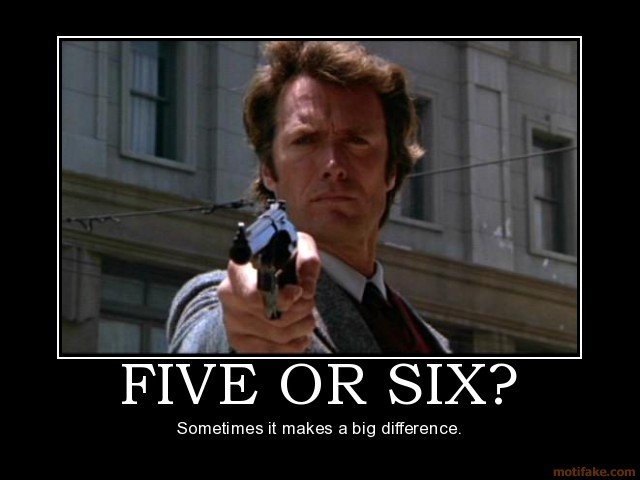
[caption id="attachment_3550" align="alignleft" width="300" caption="Dirty Harry and his loaded question."][/caption]This week’s prompt is: Pushing the Envelope. Therefore, the first question one must ask is: "Do I feel lucky?" Okay, that's really a bit of dialogue from the classic motion picture, Dirty Harry, but a very good point which we will get to. I mean, really, what does that mean, pushing the envelope? What envelope?

For me it means just the opposite of what I have been doing since this amazing turn of events began last year when I found that publisher. With regards to my writing, I haven’t been pushing anything, other than myself to do so much more. Yet, we're not discussing working hard, meeting impossible deadlines or making our presence felt to the masses. I believe that "pushing the envelope" refers to pushing past one's comfort zone. To move beyond self constructed barriers. To do what is not comfortable.

I am not a marketing guy, but I think I have been bright enough to know not to alienate potential buyers of my novel. Therefore, I have not mentioned in any short story, novel, post or article which side of the political fence I may or may not reside. I have stayed away from any and all incendiary topics. Not only this, but I have also attempted to shy away from small things which could also get feathers ruffled, such as what form of music I have little appreciation for, or which sports teams I follow. Some of these things probably sound rather trivial to some, and most certainly, some of these things will eventually be made known (Country Music; Dallas Cowboys and Chicago Cubs). My point is that in the beginning I wanted to try to be able to reach every facet of my potential audience.

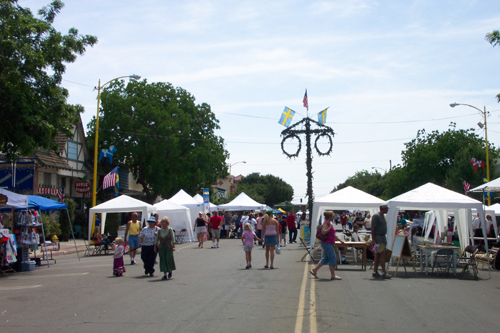
[caption id="attachment_3551" align="aligncenter" width="300" caption="Draper Street, Swedish Festival"][/caption]One example that I can give is The Kingsburg Swedish Festival. The city that I live in has Swedish roots. Therefore, our colors are Swedish; our buildings have a Swedish architecture; for all intents and purposes, we are a Swedish town. Once a year in May, we hold a festival which draws thousands. Years ago, the festival used to be held in our large park. Before and after our Saturday parade, people would head back to the park where the vendors and food booths were located. We had shade and comfortable grass to walk upon. Eventually, it was moved downtown to what we call our main street. Now we have to walk on cement and asphalt, and have little shade from the sun; but the consumers can walk amongst the shops and thus boost the downtown. Recently, there was a Facebook movement began which hoped to move the festival back to the park. However, since I am now a member of the Chamber of Commerce, you must now see that I declined the invitation to side with one side or the other. I think any reasonable person who has attended the festival would probably know which choice is best, but I am staying away from the subject.


Now, having said all of that, is this really what we mean? Or is it something more?

There is another way that one could push the envelope. My novel is a Christian/Horror crossover. It has a little bit of both and, I hope, is just the right combination to make the novel interesting, fresh and gripping. Now that it has been out for seven months, and I have begun to grow a small following across social networking sites as well as in my hometown, and the audience has begun to know what to expect from me, could it be time to push against their comfort zone? Do I now release a dark and pure horror novel where the devil seems to win more than he loses? Or do I release a purely Christian novel? How about Romance? I could do that, you know. I reach for the romantic comedy DVDs quicker than my wife does. Don’t think I couldn’t! Perhaps I could really shake things up by writing about the rape and murder a young girl much like The Lovely Bones.

What do you guys think? When might it be time to do such a thing? Too early and one might lose an audience before they have that trust factor where they’ll follow you anywhere; too late and they might feel abandoned. I was going to cite Stephen King, but because his writing is so prolific and his audience so varied that he probably did not notice the couple of times that I quit reading him. Of course, he knows that we sometimes come back.

[caption id="attachment_3552" align="alignleft" width="212" caption="See! I told you."][/caption]

Wednesday, August 25, 2010

Let the fruit throwing begin!

A great title... it bears so little resemblence to my post this week, but it is a colourful idea... (thanks C.J.) Watermellon is big here in Greece and it is such a bright colour!


Well, what would the alternative have been?

A more mundane "FIVE THINGS" I suspect! Anyway, I shall continue!


I can announce that Greece does have the internet... but, after 10 days of burning my fingers out on the keyboard of my laptop, working on the sequel to River of Judgement, I have not been checking my emails as diligently as I should (it is also supposed to be a family holiday!) Quelle suprise! When I came on line this evening, to post the blog I had written poolside this morning, after checking the schedule at the weekend, I had to do a double take! But it is too late now to find a new horse, let alone write a new post, so here goes...

FIVE THINGS (no, not five items of fruit, C.J.!)

Expresso, chilled water, ouzo, good wine and good food…

And...

Company of course, to share all the above!

[caption id="attachment_3284" align="alignright" width="224" caption="Such a hard life, writing!"][/caption]

But, as I sit here at the poolside bar in the Eagles Palace Hotel on the Athos peninsular in Greece, on what is the last full day of my summer holiday, I believe I may have that angle covered!

“Five things” the program said… (momentarily in Greece, anyway :) ), more specifically list five things I would wish to see more of, in the genre I write in. I do so love these challenges!

I think I might have mentioned, in a previous post, how I am not a good reader (I read very little, for a writer) and how I tend not to stick to a genre label. I am writing a story about a number of characters in a certain situation. It just so happens that the situation – and its consequences – gives rise to some fundamental characteristics. These characteristics may be shared by others stories and, low and behold, a collection of stories that share enough such characteristics becomes labelled a genre.

My own view is that we are conditioned too much by the process of publishing that, for marketing considerations, is driven by the requirement to segment audiences. Publishing is just like any other industry. It has to follow rules of supply and demand. Market research and segmentation is just another facet of commercialisation that removes the need for people to really think about things! OK… So, we live in the real world, I concede this fact… but where is the art in that?

(As an aside, I feel I may be digressing a little here. Perhaps it is the effect of all the ouzo I have drunk in the last ten days? But, no excuses, I shall return to the focus shortly!)

[caption id="attachment_3283" align="alignright" width="224" caption="Which one, Dad?"][/caption]

I asked my young son, Finlay, what he enjoys in the stories he reads… he likes mysteries, and action adventures. He is nine (going on 59) and his reading age is such that the books he has started to read contain profanity, which we have been telling him is wrong! But that is another issue… (Had this post been about five things I would like to see less of in the genre I write in, then I could happily expand this point!)

Finlay’s wish is to see more series. He likes to get to know his characters, and this makes him want to read his books faster so he can find out what the hero is up to in the next one! Maybe this is genetic. His mother (she declined to appear in a photo) gave a similar response when I asked her what she likes in stories – and she reads across multiple genres. Although the series angle was played down, the idea of getting to know the character was certainly important.

Where does that leave me? I used to read, and read a lot. I, too, loved series. (There you go! It is genetic!) Westerns, Sci-fi, James Bond. I loved complicated multi-faceted plot lines. Could I possibly cast my mind back and come up with areas that influence my own writing. Well, for the purposes of brevity, and avoiding further procrastination and digression, here goes, in no particular order of importance…

1) More life in some of the characters.  I am not quite talking of writing that brings characters to life here, though that is also important. (As I said, I would prefer the “less of” rather “more of” approach.) How about more life as in less death? OK, so I am crossing borders between crime, thrillers and such, but, really, do we need quite so many deaths to make a good story? High body counts to me smacks a little of sensationalisation.

2) More mundane events. Mundane? Yes, but I thought thrillers and suspense and crime are all supposed to be the antithesis of the mundane. True, but, again, the less is more approach. Why do the high body counts in many “in-genre” thrillers and crime novels also feature such horrific, mutilations of the victims? Do they all die such horrible deaths? Is every criminal also a sadist? I think not! People do die in crimes; sometimes passion leads to excess, but not all crimes are passionate. Many crimes occur as a consequence of circumstance.

3) More suspense. Most definitely! Especially if I have just reduced the excesses of criminal intent. I want the words on the paper to be put there with a purpose – I want the author to “play” with my mind, to “caress” my thoughts, to enlighten my senses. I want the words to act with subtlety, not shock. Like the chords and melody of music come together to build tension then release, I want the words of the story to do the same. I want each section and chapter and sub-plot to be put together with the same thought… to build tension then release. All the while contributing to a whole, in which the intensity of suspense builds through to the very end.

4) More story telling. OK, someone told me some days ago (and I apologise that I cannot remember who) but the Titanic was built by professionals and the Ark was built by amateurs (oops… wrong “arc” still, it gives me an excuse for a brief diversion). But, please, do give me a meaningful story arc to follow. As with suspense, I believe the concept of a story arc should apply at a levels of good fictional narrative construction. The beginning, the middle, and the end. Like a good rainbow, the story arc should climb (suspensefully, in my case) out of the beginning, and lead my eyes on a journey of wonder through clouds of inspiration, before dropping down to its root in that pot of promised gold! And I do so wish not to be disappointed when I get to the end of the rainbow!

[caption id="attachment_3286" align="alignright" width="150" caption="And one for C.J. (smiling, here!)"][/caption]

5) Finally, more plausibility. Unless I am blessed with a visit from the author’s very own muse, to sit on my shoulder and help me translate some of the implausibility gaps, the seemingly impossible transcendences, the missing or unbelievable contexts in which some writing seems to be set in, then the story must lead me, effortlessly from my current place of very real, plausible, existence, into one where I can see all the story elements working together to show my a new reality. Even gothic horror and spiritualism can be handled within a plausible reality. All it requires is a measure of sensitivity on the part of the writer. Good writing will always attract cross-over readers – broadening the audience for readership. And how good will that make you feel?

When someone tells you that they don’t read your genre, but that they couldn’t put your book down, how high will you be flying? And I am not refering to my flight back to London tomorrow morning!

Happy writing and reading :)

Tuesday, August 24, 2010

Like "Duh!" Without the Plot, Where Would We Be?

On The Hills, of course, but that's a story for another time.

Okay folks, this week we’re talking about the five things we’d like to see more of in our genre. Well, for one I’d…what was that?

Oh, we’re actually talking about the other topic. Hmm, this is awkward. Everyone knows how hard it is for me to write things on the fly.

So, now the topic is what comes to mind first when I have a story idea?

I’d like to say character, but, many of you who have read my stuff are saying: “What characters?”

Well then, how about plot?

That sounds good.

Truthfully, that really is how my story ideas come about. Usually, I have this weird dream where I won’t remember people’s names and I’ll just have to write down what I remember. I can always create characters and settings later. Surely you don't think I just instantly thought of characters like Mariah Abernathy, Jesse Campbell, Cantrell Ryker and Devereaux Marshall Fox. Despite what you all have thought for years, they took a long time to develop...after I did the plot or main story line.

For me, the plot must come first. And, unlike most of the crap on SyFy, it has to make sense to ordinary people (normally it should make sense to me, but I'm a strange bird altogether; Hunter S. Thompson without the "medicines").

For example, a few months ago, I was at Stone Mountain Park in Stone Mountain, Georgia. I was hiking the Cherokee Trail when this fabulously fit woman jogs past me. Imagine Michelle Rodriguez mixed with bodybuilder Jodi Leigh Miller (see photo), with a touch of Angela Bassett and Rachel  McLish.

Anyway, I immediately began to visualize. Okay, I immediately began to fantasize, whereupon I walked into a tree and nearly slid down a rock face.

I’d already been envisioning a story about the dark woods earlier because it was almost dusk. Now, with my head on straight and my vision single rather than double, I furthered the plot. The woman had suddenly started sprinting, as if she were being chased by someone, only to slow down soon after. She was doing wind sprints – jogging, sprinting and then jogging again.

Hmm. Jogger sprinting frantically through darkened woods. Why or from whom or…from what? I didn’t need the character yet, but I used her anyway because of her fantastic…assets. Yeah, I can be a dog sometimes, but a creative one.

The plot became a chapter in Red Herring.

For the sake of those who haven’t eaten, I won’t explain where I got the idea for the prologue to Red Herring.

As you can see, once you have the plot or idea in your head, you can fill out the rest. Say you want to take a rocket to the moon. You can think of NASA and create characters like real astronauts. Or maybe you  make it a private concept and then imagine someone like  Andy Griffith becoming a space salvage expert in Salvage 1 (wow, how old am I?).

That’s not to say that thinking of the character first doesn’t  work. Ian Fleming was literally one of the men who helped  build Britain’s famous MI-5 and MI-6 intelligence agencies  (and had an indirect hand in building the OSS, predecessor to the CIA). So, it was easy for him to think of a character first and then fill in the plot as he just scratched together amalgams of cases he worked on in World War II and the Cold War.

[caption id="attachment_3265" align="alignright" width="94" caption="Ian Fleming"][/caption]

Still, for me, plotting first works best. I went through 20 years worth of plots with what eventually became Land of the Blind. I kept trying to create characters first and they ended up moronic and silly (Star Lobster, Plutonians, Skyler Wilkins, etc). Only after I serious began plotting did I have the ability to make characters who could fit the scenarios I’d envisioned.

Or take Crawl (more on this in a minute), my first novella. I dreamed up a plot about spiders battling. Once I got the plot done up, I decided on the setting and, from there, the characters I wanted. All that, though, needed a viable plot first.

Invasion of the Body Snatchers, Black Empire, Starship Troopers,20000 Leagues Under the Sea, War of the Worlds, The Time Machine, Murders in the Rue Morgue, Frankenstein, Necroscope, Mists of Avalon, Lord of the Rings and many more great novels all needed and had their plots thought out first. Settings and characters came later.

So, don’t take it from me. Take it from centuries of great writers.

Plot some soil in the creative regions of your mind.

Note: After years of watching C.J., Wendy and David offer up their books for contests, I finally get to add one of my own to the pile. It seems that the other guys have finally forgiven me for that other...uhm, thing, so let’s just say that to any newcomers who sign up for Wicked Writers and leave a comment (a real comment, not one of those writing.com “I just want the 500 gift points” kind of comments) will get a first-run edition of my very first novella Crawl.

Also, any current member who leaves detailed comments on my blog and my alter-ego Anastasia Pergakis' blog next week can get in on the contest. And the prize is certainly worth it.

Everybody who has read this first edition by Lulu.com has liked it so much they tell me they can’t give it away for free. Well, it’s good that people want to pay for it, but you can get yours for free.

Don't wait. This contest only runs for the next two weeks.