Showing posts with label Greg. Show all posts

Tuesday, June 28, 2011

Where Is My Head (Hopping) At?


Where Is My Head (Hopping) At?


This week’s topic is interesting, to say the least and, like the adverb, generates a lot of negativity.

I’m talking about Head Hopping.


Sounds like the plot to The Hidden.


Or a weird version of Whack-a-Mole.

Or to something perverted – namely the sight of teenage girls sucking the innards out of crawfish craniums.

By definition, head hopping is where you constantly switch the points of view in a scene by literally hopping from head to head. Some authors can get away with it. Agatha Christie managed to put one over on us with The ABC Murders, but she was, after all, Agatha Christie.

I am not.

Also, many writers, editors and bloggers are not big fans of multiple POV’s per chapter. If so, I’m screwed because my books often have multiple POV’s because my characters stay busy. My plots are more like television shows. A chapter might start out with the boss at a factory discussing layoffs, then move to the shop foreman chatting with his buddies about the situation and finally end at the foreman’s house where his wife and her friends talk about what they’ll do if their husbands are laid off.

I can’t make each POV its own chapter. I’d have 60 chapters. Ditto for scene changes or scene breaks to change POV’s. If the wife is chatting with six others, all of whom are married to important characters, I can’t see creating seven scenes of them all talking about the same thing but from a different viewpoint. Anybody who knows me knows I have enough trouble keeping my books under 100,000 words.

But, these are just my opinions. I googled some things and came across some differing viewpoints, including Canadian author Crawford Kilian described head hopping this way for the blog Writer Unboxed:


Whoever is the point of view for a particular scene determines the persona. An archbishop sees and describes events from his particular point of view, while a pickpocket does so quite differently. 
So the narrator, in a scene from the archbishop’s point of view, has a persona quite different from that of the pickpocket: a different vocabulary, a different set of values, a different set of priorities. 
As a general rule, point of view should not change during a scene. (RR: italics mine) So if an archbishop is the point of view in a scene involving him and a pickpocket, we shouldn’t suddenly switch to the pickpocket’s point of view until we’ve resolved the scene and moved on to another scene.

Michelle Styles, in an article for eHarlequin, took a different point of view (no pun intended):

Right, why then do people go about staying in a specific point of view? 
Why is there all this fuss? 
The reason is reader identification with the character, in other words -- connecting with the reader. 
If the reader is going to be inside a character's head, the reader wants to know which head she is in. It is disconcerting for the reader to be pulled out of the story because she thought she was in the heroine's head and it turns out that the writer has dipped into the housekeeper's head for a moment. 
Or another way to look at it is that the reader is always seeing a scene through a filter, whether it is the filter of a character or even the filter of the ominscient (sic) narrator. Without that filter, the reader has no idea how to interpret the scene. If filters are changed awkwardly, or the reader thinks she is seeing through a specific filter and finds out differently, the reader may get pulled out of the scene. 
Thus it is the awkwardness of the shifts without sufficent (sic) tension/page turning quality that causes headhopping. If there is sufficient page turning quality, the vast majority of readers will forgive an awkward point of view shift. It is really ALL IN THE EXECUTION rather than in some hard and fast rule that says each chapter must be only shown from one character's point of view.


Alas, those who jump all over head hopping outnumber those who see nothing wrong with it, if it is done well. Sort of like the people who want to get rid of adverbs.

Within a very short time, you all will have read (or, hopefully, will read) some of my work – Crawl, They Call the Wind Muryah, Hunters, Slow Boat to China, Land of the Blind and The Light At the End of Time. I am sure you will come across head hopping. Some of you might be annoyed; others might catch on and like it. I have a feeling that most of you will not care either way, as long as the book is well-done.


Tuesday, April 19, 2011

Time to Kill

Wow! A free topic this week. In what way can I bedevil C.J. this time?

Okay. She’s on vacation with the family, so I’ll let her slide.

Instead, I’ll try to be serious for a change. I think I will talk about taking my game up a notch.

Recently, I moved again.

Stone Mountain in Georgia (that's my house on top)
Initially, I came to Stone Mountain, Georgia from Fort Worth, Texas in December of 2008, looking for a fresh start. During that particular move, I was extremely worried about a lot of things – finding employment, looking for new friends, getting adjusted to a new area after 16 years in Fort Worth and, finally, if I would be able to continue my writing (not knowing if I’d be able to set up my computer to type).

28 months later and I can call the Atlanta experiment a general failure. Even though I did get to do a lot of background work in movies like Lottery Ticket, Life As We Know It and Detroit 1-8-7, the only steady employment I found was a temporary position with the U.S. Census Bureau (ironically, that job actually prevented me from getting a bunch of screen time as a bad guy who takes on Vin Diesel and Tyrese Gibson in the upcoming Fast Five).

Now, I am in South Carolina with more relatives, but with a definite time limit. Should nothing pan out here, I will continue north to my father’s house in Boston or maybe I’ll stop over with relatives in Baltimore.

Brice Stadium, U. of South Carolina
Again, now that I am in South Carolina, I have the same issues as in Stone Mountain. Which all leads me to the vital question – where does my writing fit into this new situation?

What I mean is what is my ultimate goal for writing and what must I do to get to the next level?

This task is difficult enough for those who have a permanent residence. But, what about those without one? As the economy continues to stumble and finding employment gets more frustrating, where does writing fall into this?

I will admit that writing, for me, is a great stress reliever. However, it is also creating pressure all around to curtail the fiction and concentrate solely on job searching. As you’ve read with C.J., sometimes it seems like there aren’t enough hours in a day to write, edit, design, etc. and, of course, the primary portion of my time must be devoted to job searching.

That old chestnut of devoting an hour a day to writing is, I think, all well and good for the layman. But, add in research time and an hour doesn’t quite cut it. Even more time is necessary to prepare writing to be sent out to potential publishers. And, again, as C.J. can attest, one must find time to do all that is needed to actually get a book to the bookshelves.

Am I reaching a point where I really need to be getting published and not just in e-zines? Is it wise to hold off on trying to get to that next level until my situation is more solid?

Should I be using this free time to throw myself deep into writing while I have the chance (if and when I get a full-time job, I might not have the time to devote to my craft)?

A lot to think about, eh?

What do you guys say?

Tuesday, March 8, 2011

Thank-you Notes? No Thanks

It seems we have a curious topic at Wicked Writers this week.

It deals with thank-you notes and have we ever sent t hem out.

Going by C.J.’s blog yesterday, it seems that she is referring to sending out thank-you notes to authors after reading their books.

Hey, that might float some people’s boats, but not mine. Honestly, my version of a thank-you note in that case is:

“Hey, I just paid $$$ for your book! THANK YOU!”

By the way, that’s what every book sales receipt implicitly implies.

Think about it if you’re on the other end of this note. You write a book. It gets published and someone buys it at Barnes & Nobles (or Borders if they happen to live close to the one remaining store). You get royalties from the book sales.

That’s all you should expect.

You’re probably not going to get a thank-you note. If you do, you have the makings of a fan club.

OR…

You have the makings of a stalker.

It depends. If the note begins “…just wanted to thank you for a superb story,” you’re probably safe.

If it begins, instead with “I’m your biggest fan,” then, you’re probably in a lot of trouble.

Maybe I’m being cynical, though anyone who knows me knows that would hardly ever be the case. Getting a nice thank-you note from a sincere reader might just be icing on the cake for an author, especially a first-time author.

Seriously, though, it has never occurred to me to write any author a thank-you note for a book I’ve read. As I mentioned earlier, if I paid for it, that’s enough. If I read it in the library, it’s public domain material and the public is notoriously fickle, “fickle” meaning “not all there.”

As Frank Drebin (Leslie Nielsen) once said “Is it just me, Ed or is the whole world crazy?” to which Ed (George Kennedy) replied, “No, it’s just a small percentage of the population.”

Another thing to consider is that most authors don’t get the fan mail directly. With all the kooks and nuts and groupies out there, it’s dangerous to ever list your home or mailing address. Instead, the fan mail usually goes to the publisher, who then has a lackey go through it, looking for threats (and perfume and panties and bras and room keys and Google maps to homes…).

Besides, a lot of authors use pen names anyway, so you’d never be sure of finding the real address anyway.  Depending on your genre, that might not be a bad idea, since we can’t all live in small-town Maine where a stranger who runs down a famous author and never apologizes dies under mysterious circumstances a year to the day, hour and minute.

Which bodes ill for me since I use my full name (what with all the Gregory M. Smiths in the Atlanta area alone).

Memo: When I become famous, get unlisted phone number and listing in phone book. 
P.S.: Provided they even make phone books anymore.

On a lighter note, I do think it is polite and necessary to send thank-you notes for critiques. If someone takes the time to make a critique, however negative (or however positive if you’re reading something from any Wicked Writer with a full first name), you should thank them for taking their valuable time to read your work.

No matter how shocked they might have been by the intensely erotic XXX sex scenes or how bewildered they might have been by the fact that the denizens of the supernatural are now sex symbols, thank them anyway.

Do unto others as you would have them do unto you.

Tuesday, February 22, 2011

I've Got Your Critique Right Here

This week, we get to talk about critique groups.

Let me start out by saying that I really am behind the times. For the bulk of my writing 
career, my critique group was whatever copy editor got my article. Of course, this wasn’t a true critique group because it was rather one-sided. I basically kept control of what wasn’t bleeding red.

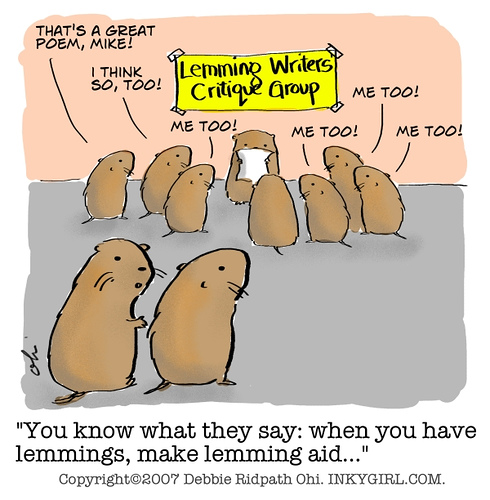
Nowadays, the best I’ve done for critiquing is Writing.com (and, even with that, I usually have to offer gift points as incentive). I just joined Writer's Cafe so I can't even tell you what it's all about. Besides, my philosophy about critique groups was, for the longest time, typified by this cartoon:


Honestly, though, the times I have tried critique groups, I leave because somebody always hijacks the thing. For example, on one site that shall remain nameless, a few people jumped on me for using adverbs, you know, those words that end in "-ly" and more accurately describe things like verbs and emotions (by their views, I couldn't even say "accurately"; I'd have to be verbose and say "...describe things like verbs and emotions with more accuracy").


Look. Just because someone didn't pay attention in high school English or is too freaking stupid to understand one of the parts of speech we all spent 12 years learning is not reason enough for me to quit.


I mean too many people, including critique group members, have already thrown away the dictionary, judging by the horrible spelling I've seen. No sense adding adverbs to the mix.


Anyway, suddenly, everybody and their mother was carping on me for having the gall and audacity to use adverbs. Somehow I had thought critiques were meant to offer suggestions, advice and corrections.


Okay, that's it for me.


Since that’s all I really have to personally offer about critique groups, let me give you some references so you won't feel like you just wasted 15 minutes of your life.

So, for the convenience of our Wicked Writers readers, I’ll list a few who have compensated me for my time and endorsement (just kidding; I endorse no one):


DON’T see any you like, try creating one of your own. You can either pick C.J.’s brain (at your own peril) or try these helpful instructions courtesy of eHow.com:

1.  DECIDE ON SCOPE. Do some groundwork ahead of time. Some things to think about are: the desired number of members (4-6 is ideal), the genre(s) of the work to be critiqued, whether you want a facilitated group or a free form style of operating, frequency of meetings, and how the group will conduct itself (for example: read works al0ud in meetings, or read works prior to meeting).

2.  ADVERTISE. The most effective way to find group members who are serious is through a local writer's association. Do some research on-line to locate any associations in your area and become a member. Writer's associations often have annual conferences where you can post a notice that you are starting a critique group. Writer's associations also often have newsletters where they will advertise critique groups seeking members. Other advertising vehicles are community newspapers and Craigslist.com, which reach the general public, so expect a wide array of responses from serious to not-so-serious. Your ad should specify any requirements for members, such as genre limitations, location, and frequency of meetings.
Example of an ad:
"Seeking members for Young Adult Fiction Writer's Critique Group in Springfield. Meet monthly. Published and unpublished writers welcome. Contact J.K. Rowling at xxx-xxxx if interested."

3.  SCREEN RESPONSES. Once the responses start rolling in, contact the respondents and have an informal chat. Try to form a first impression to determine whether you think he/she would be viable candidate for your group. Ask yourself a few basic questions. Is he articulate? Does he listen or talk over you? Does he consider himself a beginning, intermediate, or advanced writer? In your discussion you should determine whether he meets the basic requirements specified in your ad: genre, location, availability for meetings, etc.

4.  SELECT MEMBERS. In talking with the candidates, try to form an opinion on their potential compatibility. If you believe you've found a viable candidate, ask him to join on a trial basis. Be clear that if after the first few meetings, you determine that he is not right for the group, you will ask him to leave, no hard feelings. Likewise, if he determines the group is not meeting his needs, he can quit the group.

5.  FIRST MEETING. Hold your first meeting. A neutral venue is best because no one will be distracted playing host. Consider venues like a coffee shop with a private room or a public library. In the first meeting, establish and agree on the ground rules. For example:
* Meetings will be the first Saturday morning of every month.
* Each member will send out material for critique one week in advance of the meeting.
* Members will read the material and prepare comments for the writer.
* Critique will focus on the broader aspects of writing (theme, character development, etc.) rather than line editing.
* Each member will have five minutes to give a verbal critique of each piece being critiqued.
* The author may not interrupt or make comments during the critique; he should just listen and soak it in.

6.  FIND YOUR STRIDE. You may not have the desired number of members in the first meeting, and might have to add members after the group is established. Orient new members to the groups mode of operating. After a few meetings, you may find that a few of the rules relax. For example, you may find that members, as relationships are established, will make comments while their work is being critiqued. Remain flexible as long as the group is functioning well, and members are receiving objective, meaningful feedback on their work.

Tuesday, November 16, 2010

Giving Some Thanks -- the Write Way

As I sit here at the computer, still digesting that fantastic meal from Golden Corral, I found myself reflecting on the topic of being thankful.

Now, this isn’t because it’s almost Thanksgiving, but more about why I was digesting the “wonderful” meal from Golden Corral. See, it was Military Appreciation Day and good old GC was treating veterans to a free meal (in case you’ve never heard of Golden Corral, it’s a buffet-style restaurant; a meal is whatever number of trips through the buffet line your stomach can handle).

Last Thursday was Veterans Day and a bunch of restaurants treated vets to an array of freebies, ranging from a free appetizer (like the Bloomin’ Onion at Outback Steakhouse) to an entire menu (Applebee’s). I can only imagine what would happen if Hooters joined the movement.

Being solo on these jaunts, I ended up sharing tables with others and got to hear their “war” stories and military tales. It made me wonder about these future generations are going to cope. I could remember all the discipline that military life had introduced into the lives of us veterans.

It made us productive citizens (most of us, anyway). The kind who built this great nation, brick by brick, girder by girder and X chromosome by Y chromosome.

Alas, it seemed as if the veterans’ appreciation is destined to become like Christmas – that once-a-year event where we all suddenly remember to be good to our fellow human beings, though even that is disappearing fast in an age of disaffectedness and political correctness.

For all the wonderful bits of technology we have available to us – cell phones, iPhones, Internet, laptops – we still seem not to know that there are wars going on. The news is reduced to “NATO servicemembers killed” yada yada yada.

Unfortunately, we’ve been going down that road for awhile. In Vietnam, protesters spit on returning veterans. While I’m glad no one is spitting now, we’re doing something almost as bad – we are gleefully and naively asking young men and women “did you kill anyone over there” or, even worse “how did it feel?”

Talk about disrespect. And everyone is asking, from little kids to adults.

I don’t know anymore.

As for what this topic has to do with writing, such a culture change appears in our books. Black Hawk Down: A Story of Modern War (Mark Bowden), The Hurt Locker(Mark Boal) and Anthony Swofford’s Jarhead have showed us a war fought by the brave while the disaffected back home don’t seem to   notice. Boal appears here again with “Death  and Dishonor,” a piece that led to the movie In the Valley of Elah, a movie based on actual events in which soldiers suffering from PTSD because of Iraq kill and dismember one of their own.

Maybe we should either start writing about the bravery of our men and women in uniform and stop focusing on all the negative stuff. Soldiers, sailors, airmen, Marines and Coast Guardsmen didn’t ask to go to war, but they performed their duties nonetheless. They certainly don’t need the people they’re safeguarding to paint them all with the same brush.

And maybe we can help with a few strokes of a pen instead of a paint brush.

At the very least, don’t wait until Memorial Day and Veteran’s Day to say thanks to those who served our country faithfully and with honor.

Tuesday, November 2, 2010

It's My Duty to Inform You That...It's NaNoWriMo Time!

I don't know how this fell to me, but I'm going to leave the humor aside for one week (and I know many of you are saying "what humor?") so I can remind faithful readers about the one time of year we all really enjoy...besides Thanksgiving, Christmas, Memorial Day, Labor Day, July 4th and Halloween -- namely NaNoWriMo

For those not familiar with this event, it stands for National Novel Writing Month and was started by Chris Baty back in 1999. The challenge is to write a coherent novel of at least 50,000 words in 30 days. It began yesterday (Nov. 1) and runs through 11:59 p.m. on Nov. 30.

By that date, you'll either be beaming with a new novel or still pissed at the results of the Grambling State-Southern Bayou Classic.

Anyway, there is no actual prize associated with being a winner. Writing 50,000 words in a month and making them fit into a novel is prize enough. You do get a little banner that you can paste to your writing.com account (if you have one).

And who knows? You may find your novel getting picked up by a publisher. Think it doesn't happen? Ask Sara Gruen and her novel Water for Elephants, which hit #1 on the New York Times bestseller list. For a list of NaNoWriMo participants whose novels got picked up for publication, check this out.

If you should decide to participate, here's how to get started:

1) Sign on to the Internet

2) Go to www.nanowrimo.org

3) Sign up

Note: If you're one of the 60,000-plus who did this last year or the year before, use your old sign-in name, please. Otherwise, they won't remember you. They have the means to help you if you've forgotten user name and password. Also, remember that the word count will appear on your WDC page.

[caption id="attachment_3767" align="alignright" width="251" caption="Want to be the next A.M. Homes? Join NaNoWriMo"][/caption]

And don't worry if you've never written a novel before. A friend of mine wrote something about vampires, vacations and Alaska and it got published. And the writer was from Jersey, no less. So, it's not that difficult.

Anyway, here are a few helpful hints for writing 50,000 words in one month:

A) Be loose. Set aside time to write. Say about an hour a day. It can be morning, noon, night or late night. Especially a time with no distraction like kids or snoring spouses (hey, husbands can snore, too). Most importantly, write every day because, if you don't, it's like missing a day of exercise. You'll suddenly miss more and more and it will be Nov. 30 before you know it.

B) Have some flexibility. You might find yourself wanting to change directions with your novel. It might start out as a memoir of how you met your husband and then change into how you met and married husband no. 5.

C) Set goals. Now, NaNoWriMo suggests writing at least 1,667 words a day, but that's mathematical. Write what you can. You'll have days when you don't feel like writing much of anything and then there will be days when your significant other can't pry you loose from the computer. Go with the flow and just write something.

D) Wait until the end to edit if you must. Trust me, I've fallen into this trap too many times in the past. Think of NaNoWriMo like the SATs. With tests, you answer all the questions and, if you have time left, you go back over them. With your novel, write until it's done. Then, if it's not quite 11:59 p.m. on the 30th, go back and browse through it. (one exception to this hint: please use Spellcheck and Grammarcheck).

Also, here are a couple of books, including one by Chris Baty himself, on how to write a novel in 30 days (both available on Amazon.com):

[caption id="attachment_3764" align="alignleft" width="150" caption="By Chris Baty"][/caption]

[caption id="attachment_3765" align="alignright" width="150" caption="by Victoria Lynn Schmidt"][/caption]

Special note: The winner of the Halloween novel contest is Kris M. Kris, if you would please review my last blog and pick a title from the list, I will have that sent to you post-haste. Just leave a comment on this week's blog when you decide and then we'll go about exchanging info offline so I can order it.

Monday, October 18, 2010

I Have A Confession to Make: I'm A Fraud

Yes, you heard right.

I’m a fraud.

I’m not the horror aficionado that you all think I am.

You may have thought that after reading For G.O.O.D., Collection and Black Man With A Gun, but, really I’m still a novice in this genre. I know Crawl (still playing out in serial format in the latest issue of Spectacular Speculations; by the way, the October contest for Speculations is closed) was written back in 2003, but it is mostly science fiction.

Even though I have been writing for more than 30 years and call myself a science fiction and horror writer, I got caught with my hand in the cookie jar with this week's topic -- my favorite horror novel or the one that influenced me the most.

A longtime horror writer should have a wealth of books to refer back to. He should have favorite authors he can't count on both hands.

Sorry if you thought that about me.

I have committed some egregious sins in the horror field. I did not read Bram Stoker’s Dracula until about five years ago.

For shame!

Truth is, I’ve never been able to get through Mary Shelley’s Frankenstein, or the Modern Prometheus because I still compare it to James Whale’s classic with Boris Karloff.

I did not get enough desire to go find Daphne du Maurier’s The Birds until after I had gotten the 40th anniversary DVD edition of Alfred Hitchcock’s masterful film version.

And, most serious of all, I moved away from Boston in the summer of 1982 without reading a single Stephen King story. Yeah, me, the guy who won an ACT-SO award for a chilling ghost story in 1981 did not read the Master of Horror while actually living in New England (the inspiration for the ghost story was The Screaming Skull, an absolutely dreadful film, even by my standards).

I saw Salem’s Lot on television and it did not lead me to a bookstore. When I was in high school in Texas, I found a copy of Night Shift and only then did I get into Mr. King. Oddly enough, I love his anthologies but have not been able to really read his full-length novels.

And I think I can blame it all on H.P. Lovecraft.

[caption id="attachment_3684" align="aligncenter" width="96" caption="H.P. Lovecraft, circa 1934"][/caption]


He was the one horror guy I did read at the library (and that was initially because of the fancy covers of his books). I found myself trying to get all of his books.

But, let’s face it, folks. H.P. Lovecraft was downright weird.

One glimpse into The Call of Cthulu, The Lurking Fear, The Colour Out of Space and The Shadow Over Innsmouth and you’d think you’ve entered another plane of reality (which you have). Fates you can’t escape, no matter if you’re a thousand years removed from the incident, deeply depressing circumstances and the inability for anyone to escape.

If I want that, I'll reread Thomas Tryon's Harvest Home.

To this day, I still can’t psyche myself into writing a Lovecraftian tale.

Thus, I read his books trying to understand them because it was a great challenge for a growing and maturing mind that had already dismissed the juvenile books about hot rods and wanted more than Johnny Tremaine. But, my brain was not up to the task yet and I made no trips to other sections of the horror shelves.

Finally, though, I was saved by Mr. King. Nightshift, a collection of the short stories he wrote and sold for various magazines in the 1970s, really got to me in a way that Lovecraft could not. I understood King’s stories, for one thing. Secondly, I could identify with the characters. Thirdly, King did not make New England into one horrible cesspool just a level or two above Dante’s Inferno like Lovecraft did (King was born in Maine; Lovecraft in Providence, Rhode Island).

King’s stories like The Raft where four horny teenagers get caught in the middle of a forbidden lake by a monstrous entity reminded me of my days as a horny teen sneaking up to Silver Lake in Halifax to watch Rachel and Michelle skinny dip (fortunately, the lake had no black gunk in it to spoil my experiences – there’s a joke in there but I’m not going to say it, you perverts).

Eventually, some of King’s works have found their way into my writing. Take a second look at For G.O.O.D. and you’ll see a bit of Quitters, Inc. in there.

The truth is, though, is that I’ve never really needed horror stories to influence my writing. I can look at everyday normal situations and think of some way they can become horrible and terrifying.

That’s how Palmetto bugs became the boogeymen of Red Herring.

And that scratching in the ceiling, is that from the squirrels running around in the eaves?

Or can it be something else?

Wait, I hear something more. More than just scratching. It sounds like…like…

…gnawing!

My God, they’re gnawing through the ceiling. They’re coming after me.

They're...they're in the walls!

THE RATS!!!!!!!!!!!!!!!!!!

DAMN YOU, LOVECRAFT!!!!


Ah, another contest: Seems like I was just here. But, since my last contest went so well, I’ll take a cue from James and try again. If we can get some new reviews or comments over the next two weeks for at least one blogger this week and next, I’ll send the winner a copy of one of my favorite classic horror novels – Night Shift (Stephen King), The Birds (Daphne du Maurier), Pyscho (Robert Bloch), Stinger (James McCammon), The Keep (F. Paul Wilson) or Dark Tidings (Gregory Marshall Smith)

Tuesday, October 5, 2010

Horror You Can Sink Your Teeth Into

Can’t you feel the tension creeping into your very soul?

Just an innocent walk home after a long day of work and suddenly a hand comes out of nowhere, grips you by the throat and hurls you into oblivion. Soon you’ll feel the fangs in  your throat and the very life sucked out of you.

Or maybe you’re not at work. Maybe you’re enjoying the beach. Casually splashing about as you paddle around offshore on your inflatable raft. How can you possibly know that a killer is lurking beneath the surface, gliding silently, purposefully, ignoring all the other swimmers just to zero in on you?

How about some hill climbing? The villagers are desperate to show you the view from the top. How are you to know that a prehistoric creature, awakened by Man’s foolish atomic experiments, will stick its head over that hilltop and issue filmdom’s most frightening and memorable roar? You don’t care as you’ll be fleeing in abject horror from a creature that will soon turn thousands of your fellow countrymen – innocent men, women and children – into funeral pyres.

Might as well seek the peacefulness of the country. Nothing can go wrong there, right, not like in those big cities? Hmm, sure are a lot of cats and dogs missing. Should I leave my window open tonight? What’s the worst that could happen? Maybe an eight-legged neighbor and about a million of his closest friends will drop in?

Hello and welcome to the world of my nightmares, better known as the horror movies that inspired and influenced me.

If you haven’t guessed, I am talking about The Night Stalker, Jaws, Kingdom of the Spiders and Godzilla.

These films were highly influential on me as a kid and even as an adult. Each one had a different effect on me, effects that I now find myself using a lot in my horror and science fiction.

I remember not going into the water for a long time after seeing Jaws in 1975. An intelligent shark? Who would’ve thought it? I mean, getting Chrissy Watkins for swimming nude at night was one thing, but ignoring allthose people at the beach to zero in on the kid on the raft? Well, that did it for me. If I was really brave, I’d go out waist deep at Revere Beach or Cape Cod, and I had trouble getting close to the gunwales of the ferries on school field trips to Nantucket (where they really filmed Jaws).

Now, you’ll find me using that silent, creeping-up style of terror in my short stories like the prologue to Red Herring that I told everybody not to read right before bed. Are those cockroaches on your legs or just the wind caressing your hairs?

The Night Stalker was the highest-rated TV movie of the time when it aired in 1972. Of course, I was only 5 when it aired originally, so I didn’t see it for a few years. And then when I did see it, it was on late at night. Right before bed. Good timing, eh?

Darren McGavin’s stark, matter-of-fact narration and the vampire's running battles with the police certainly didn’t look like Bela Lugosi or Christopher Lee’s Dracula.

Somehow, I think McGavin’s Carl Kolchak might have inspired me to become a journalist. I didn’t cover the weird, the supernatural or the horrible (no, I left that to the guys covering the Cubs) but I had the writing bug nonetheless.

Now, Kingdom of the Spiders could have fallen flat because of the hammy  William Shatner as the lead guy Rack Hanson. But, director Bud Cardos was

[caption id="attachment_3560" align="alignleft" width="300" caption="No beaming out of "Kingdom of the Spiders""][/caption]

able to overcome that with some tight direction, good camera work and  about 10,000 real tarantulas. Yes, folks, those actors and extras really were  covered with live tarantulas!

One particular scene that creeped me out was when the sheriff (played by the Marlboro Man) has to tell Altovise Davis that her husband, played by Woody Strode, has been killed by the tarantulas. As the scene unfolds, a tarantula sits on a fence, watching it. When she hears the news and bursts into tears, the spider slowly crawls away as if it had been waiting to see if the handiwork of its companions had the intended effect.

From that movie, I got the idea to use nature against Man and to do it in a way that could not be solved at the last second by the military or by some hastily-created weapon. William Shatner couldn’t overcome the tarantulas (and actually had to be rescued by Tiffany Bolling), so why should my characters in Crawl be one-man armies? That relentless wave of eight-legged horror (especially the scene where they’re leaping at the shoes of the little girl on the swing) was light years better than the CGI in Eight-Legged Freaks.

And, finally, last but not least is Godzilla. I’m referring to the American version with Raymond Burr.

You see, up until then, monsters created or affected by nuclear radiation threatened mankind only to be taken out by the military (Them!, Tarantula) or by science (Beast from 20,000 Fathoms, It Came From Beneath the Sea). But, here was Godzilla, a creature that withstood Man’s weapons and even wiped out a tank corps. He melted electrical towers with radioactive breath and burned thousands of innocent people to death. Yes, he was finally stopped by science, but the scientist responsible didn’t make it to the end nor did he get the girl. That never happened to Kenneth Tobey, Jeff Morrow or James Arness.

No giant monster movie has affected me like Godzilla. Not even Jurassic Park or Cloverfield. Those films were gimmicks or cliché plots about people trapped in confined spaces against monsters. Godzilla predated all of those “nature takes revenge on Man” films that have followed since. The black & white photography, the realism (the ship burned up in the beginning was based on the real-life incident of the Lucky No. 5 that wandered too close to the H-bomb test), Raymond Burr’s stark narration, the monster’s relentless assault on Tokyo, they all worked together to create a sense of dread and doom like no other, pushing a sense of helplessness.

Is that what we are truly supposed to feel when we watch horror? Are we supposed to feel helpless, like Dennis Weaver in that beat-up old car trying to outrun that maniacal trucker in Duel?

Is that my job as a horror writer? Am I supposed to yank away your security blanket and leave you hiding in the closet hoping, with baited breath, that the person opening the door is there to save you?

Well, am I?

Okay, okay, just relax, folks. These are all just movies. Nothing to really be scared about. In two hours or less, they’ll be over and we can all get back to the horror of the real word, right?

Right.

Oops, getting late. Better get ready for bed. A nice warm shower…ah, that hits the spot. See, all of the terror I created is washing down the drain.

Wait, did the bathroom door just open?

Hello, is anybody ther--

Monday, September 20, 2010

All Rolled Into One

My, what an interesting topic this week – have we ever gotten revenge on someone by writing them into one of our stories?

Most people who know me know that I never put any real people into my stories. Heck, I don’t even put myself into my own stories.


Wow, that was a little too close.

Point taken.

Truthfully, I sometimes have a tendency to put people I know into my stories. For the five or six of you who have read my previous blogs, you know that many times I’ll take parts of real people and meld them together into an amalgam.

I’ll also imagine (aka “fantasize”) about certain actresses who might play a role if my novel or short story were to make the big screen. That’s why Michelle Rodriguez, Angela Bassett, Linda Hamilton (looking much better on yesterday’s episode of Chuck than she did six months ago in real life) and Anabella Sciorra keep showing up repeatedly in my posts.

And I have been known to do away with more than a few enemies in my novels and novellas. A female classmate of mine in junior high tried to bully me. I tried to be the gentleman and not cold cock her when she slapped me repeatedly. I held out as long as I could before I belted her one. Then, I got home and got a different kind of belt for my “self-defense” (courtesy of mom).

(Note: You should never hit a woman, I know, but she was slapping the crap out of me; I lost feeling in my left cheek).

After serving a month’s grounding, I decided on a different fate for the would-be bully. So far, she’s met horrible fates in at least 10 stories, including the NAACP ACT-SO regional award-winning one-act play Ghost.

If you knew my back story, you might find some other enemies (and one or two back-stabbing psycho ex-girlfriends) meeting cruel fates in Black Man With A Gun, Next-Door, Society’s Children, Wrong Choices, Skyfall, Slow Boat to China, and Collection. A few double-dealing shrews associated with MMP (a defunct publishing company) might suffer unimaginably in Red Herring and Farm Report. For my female readers, I won't mention all the women associated with stages and poles who have gotten my ire over the years (oh, wait, I just did...whoops, sorry).


And don’t get me started on how many “targets” bit the dust in Land of the Blind. I think I may have been angry at the entire southeastern United States. Or it was probably just the Army. Go Navy!

Right now, I have a real doozy of a target. This woman I met online once threatened to tear both my arms off and beat me to death with them. Even worse, she’s from New Jersey. Is that even a state? Ah, yes, my revenge will be sweet in the sequel to Hunters.

So, remember this one thing. If you have enemies that you want to get back at, try writing science fiction and horror. They’re really great vehicles for getting vengeance.

And I will end this now because I’m really starting to creep myself out.

Note: My apologies for not announcing the winner of my contest. I was surprised that so many people commented on my blog from a few weeks ago. I was concerned because the usual one person in my fan club was sick and missed reading me.

The winner of the contest is Sharon Hamilton, whose reviews are always in-depth and informative. Sharon, if you’ll drop me a line on gmail about how I can send a copy of Crawl to you, I’d appreciate it. Last I heard, the novella is so hot copies are flying onto the shelves.

Also, I think I’ll have to give J.D. Brown an honorable mention for admitting to blushing at the description of the female runner in Red Herring. Took a lot of guts, J.D. Get in touch with me and I’ll give you a coupon code or something for a copy of my e-book Dark Tidings (your choice of volumes I or II).

And, please, ladies, get in contact with me soon before C.J. really kills me this time.

Note 2: If anyone’s interested, I may be making my television comeback tonight at 10 p.m. (Eastern)/9 p.m. (Central) on ABC’s Detroit 1-8-7. I’m a senior detective (the other black guy with the ugly green, brown and orange-striped tie) in the night-time hostage scene with Mike Imperioli (The Sopranos) and James McDaniel (NYPD Blue).

[caption id="attachment_3459" align="alignright" width="300" caption="Detroit 1-8-7 (no, I'm not either of the black guys in the photo)"][/caption]

This will be my first appearance on TV (other than America’s Most Wanted) since I played Speed Channel photographer Tony on “Team Cherokee, Part I” and “Team Cherokee, Part II” on Walker, Texas Ranger in 1999.

Also, I’m in the front row of the church scene in Lottery Ticket for those brave enough to see that movie and I’m control room technician Greg (yes, I got to use my real name) in the upcoming Life As We Know It with Josh Duhamel and Katherine Heigl on Oct. 8.

Monday, September 6, 2010

Heroes -- Alive in Our Hearts and Books

Wow, what a tough subject this week -- 9/11 and heroism.

I was a sports writer for a major American newspaper that September day in 2001, which gives me some insight most people don’t have. I had often wondered what reporters felt like on December the 7th and by the end of the 9/11 I knew the awful feeling.

I never really thought about where I was when it happened because it seemed so insignificant to the overall scheme of things. That I was waiting for a ride to Wal-Mart to get a new battery for my car might be as inconsequential to history as you can get.

That all changed when I got to work, though. I got my car battery and went into work at the Fort Worth Star-Telegram. Not much of a sports section that night. Instead, most of us helped cover the American reaction to 9/11, got quotes from sports fans and ordinary citizens and worked our asses off for the next week to get every angle possible, especially on the background of Osama Bin Laden and Al Queda. I tell you that “useless” information everyone said I had about the Soviet invasion of Afghanistan and the CIA response in the form of the Mujahideen suddenly became extremely useful.

The only real downside was that I already had the images of the collapses of the north and south towers of the World Trade Center seared into my mind and I had to watch them over and over again that week.

To get through it, I hit the books. Literally. I couldn’t read anything about police officers or fire fighters because they would only remind me of the awful sacrifices made that unforgettable day.

Instead, I read war books. Real life stories about how America coped with past wars and how the men and women who fought them coped. I knew the American armed forces would be responding to the attack and I also knew the Taliban would be as stupid as Saddam Hussein was in Desert Storm.

The first book I read was Day of Infamy by Walter Lord, about the Japanese sneak attack on Dec. 7, 1941. That seemed most appropriate. I  followed it up  with Incredible Victory, also by Lord, about  how we won the Pacific War.

Other books about Americans triumphing over adversity soon  followed – The Great Escape (Paul Brickhill); The Short-Timers (Gustav Hasford; hint: was the basis for Stanley  Kubrick’s classic Full Metal Jacket); War Year (Joe Haldeman), and Pork Chop Hill (S.L.A. Marshall).

I also remember checking The Diary of a Young Girl (Anne Frank, Otto Frank & Mirjam Pressler) out of the library. Talk about finding positive examples of surviving through incredible adversity.

I think I ignored all the larger-than-life stuff like the Mack Bolan series because I felt comfort in reading about the true exploits of real people. Because real people died on December 7th, just like on 9/11. Real, everyday Joes and Janes signed up to fight the Japanese. Just like Americans were torn from their norms and thrown in to a seemingly impossible situation, so, too were the young men who found themselves in Marine boot camp, being stripped down and made into brutal killers for Vietnam.

These were books about people who had already been through catastrophe, had rallied together and had triumphed or provided inspiration for others to continue to live. I like Anne Frank’s diary despite her ultimate fate. I still enjoy the original movie with Millie Perkins and the remake with Melissa Gilbert, if only to remind myself that while life might suck, it will go on.

It makes me wonder what books will be written about Afghanistan and Iraq. Those wars seem so politicized and sanitized now that we Americans (and our allies) go on with our daily lives and treat them like 30-second sound bites.

Maybe we need modern versions of Stephen Ambrose’s Band of Brothers or G.F. Borden’s Seven Six One or Mark Bowden’s Blackhawk Down.

Then, we would definitely never forget that awful day in September.

Other recommended reading:

The Longest Day (Cornelius Ryan)

A Bridge Too Far (Cornelius Ryan)

Thirty Seconds Over Tokyo (Ted W. Lawson)

Flags of Our Fathers (James Bradley & Ron Powers)

Jarhead (Anthony Swofford)

The Bridges at Toko-Ri (James Michener)

The Cruel Sea (Nicholas Monsarrat)

The Bridge Over the River Kwai (Pierre Boulle)

The Red Badge of Courage (Stephen Crane)

Diary of Alvin York (Alvin York, edited by Tom Skeyhill)

1968 (Joe Haldeman)

We Were Soldiers Once…and Young (Lt. Gen. Harold G. Moore, ret. & Joseph Galloway)

Tuesday, August 24, 2010

Like "Duh!" Without the Plot, Where Would We Be?

On The Hills, of course, but that's a story for another time.

Okay folks, this week we’re talking about the five things we’d like to see more of in our genre. Well, for one I’d…what was that?

Oh, we’re actually talking about the other topic. Hmm, this is awkward. Everyone knows how hard it is for me to write things on the fly.

So, now the topic is what comes to mind first when I have a story idea?

I’d like to say character, but, many of you who have read my stuff are saying: “What characters?”

Well then, how about plot?

That sounds good.

Truthfully, that really is how my story ideas come about. Usually, I have this weird dream where I won’t remember people’s names and I’ll just have to write down what I remember. I can always create characters and settings later. Surely you don't think I just instantly thought of characters like Mariah Abernathy, Jesse Campbell, Cantrell Ryker and Devereaux Marshall Fox. Despite what you all have thought for years, they took a long time to develop...after I did the plot or main story line.

For me, the plot must come first. And, unlike most of the crap on SyFy, it has to make sense to ordinary people (normally it should make sense to me, but I'm a strange bird altogether; Hunter S. Thompson without the "medicines").

For example, a few months ago, I was at Stone Mountain Park in Stone Mountain, Georgia. I was hiking the Cherokee Trail when this fabulously fit woman jogs past me. Imagine Michelle Rodriguez mixed with bodybuilder Jodi Leigh Miller (see photo), with a touch of Angela Bassett and Rachel  McLish.

Anyway, I immediately began to visualize. Okay, I immediately began to fantasize, whereupon I walked into a tree and nearly slid down a rock face.

I’d already been envisioning a story about the dark woods earlier because it was almost dusk. Now, with my head on straight and my vision single rather than double, I furthered the plot. The woman had suddenly started sprinting, as if she were being chased by someone, only to slow down soon after. She was doing wind sprints – jogging, sprinting and then jogging again.

Hmm. Jogger sprinting frantically through darkened woods. Why or from whom or…from what? I didn’t need the character yet, but I used her anyway because of her fantastic…assets. Yeah, I can be a dog sometimes, but a creative one.

The plot became a chapter in Red Herring.

For the sake of those who haven’t eaten, I won’t explain where I got the idea for the prologue to Red Herring.

As you can see, once you have the plot or idea in your head, you can fill out the rest. Say you want to take a rocket to the moon. You can think of NASA and create characters like real astronauts. Or maybe you  make it a private concept and then imagine someone like  Andy Griffith becoming a space salvage expert in Salvage 1 (wow, how old am I?).

That’s not to say that thinking of the character first doesn’t  work. Ian Fleming was literally one of the men who helped  build Britain’s famous MI-5 and MI-6 intelligence agencies  (and had an indirect hand in building the OSS, predecessor to the CIA). So, it was easy for him to think of a character first and then fill in the plot as he just scratched together amalgams of cases he worked on in World War II and the Cold War.

[caption id="attachment_3265" align="alignright" width="94" caption="Ian Fleming"][/caption]

Still, for me, plotting first works best. I went through 20 years worth of plots with what eventually became Land of the Blind. I kept trying to create characters first and they ended up moronic and silly (Star Lobster, Plutonians, Skyler Wilkins, etc). Only after I serious began plotting did I have the ability to make characters who could fit the scenarios I’d envisioned.

Or take Crawl (more on this in a minute), my first novella. I dreamed up a plot about spiders battling. Once I got the plot done up, I decided on the setting and, from there, the characters I wanted. All that, though, needed a viable plot first.

Invasion of the Body Snatchers, Black Empire, Starship Troopers,20000 Leagues Under the Sea, War of the Worlds, The Time Machine, Murders in the Rue Morgue, Frankenstein, Necroscope, Mists of Avalon, Lord of the Rings and many more great novels all needed and had their plots thought out first. Settings and characters came later.

So, don’t take it from me. Take it from centuries of great writers.

Plot some soil in the creative regions of your mind.

Note: After years of watching C.J., Wendy and David offer up their books for contests, I finally get to add one of my own to the pile. It seems that the other guys have finally forgiven me for that other...uhm, thing, so let’s just say that to any newcomers who sign up for Wicked Writers and leave a comment (a real comment, not one of those writing.com “I just want the 500 gift points” kind of comments) will get a first-run edition of my very first novella Crawl.

Also, any current member who leaves detailed comments on my blog and my alter-ego Anastasia Pergakis' blog next week can get in on the contest. And the prize is certainly worth it.

Everybody who has read this first edition by Lulu.com has liked it so much they tell me they can’t give it away for free. Well, it’s good that people want to pay for it, but you can get yours for free.

Don't wait. This contest only runs for the next two weeks.

Tuesday, August 10, 2010

Keeping It Real

I was actually going to talk about the basics of writing, but C.J. beat me to it. So, I must tackle a subject I feel is just as important. And, once again, I received my inspiration from the crappy “original” movies on SyFy.

What I’m going to talk about is something that doesn’t exist on that channel – believability.

Even though science fiction requires readers to suspend belief, we writers  must still have credibility so people will accept them as truth or explain them sufficiently to make the accept what they read or see like the world of the  Martin Caidin’s Cyborg or just about anything by Michael Crichton.

That said, let’s look at believable characters.

Sounds simple enough, except when life imitates art. Let’s face it. A lot of us are inspired to write books not from other books, but because of movies. Movie characters, as a whole, are either larger than life or amalgams (combinations of people). This is often done for time or to allow movie-goers to only have to follow a few characters.

You should not try this formula to make book characters.

Case in point: Quicksilver (2000) by Judith & Garfield Reeves-Stevens. This wife and husband are best known for the Star Trek collaborations, mostly with William Shatner (which should set off alarms bells instantly). But,     they also jumped into the techno thriller genre dominated by Tom Clancy, Dale Brown and Stephen Coonts. Unfortunately, reality didn’t jump in with their lead characters.

Amy Bethune is a second-year midshipman who, via a couple of hand-to-hand combat classes, becomes a female Rambo, dispatching terrorists like Steven Seagal. Major Sinclair is an ex-Delta Force commando (sorry, but females aren’t allowed in Delta Force) with enough skill to persuade the President to allow her to go in alone to save the Pentagon.

Or, to balance the gender scale, clink on the link to Wikipedia to see how impossibly manly Henry Ralston’s Doc Savage was made to be.

Compare all of them to Tom Clancy’s hero, Jack Ryan, who doesn’t shoot a single bad guy while trying to escape that deadly ambush in Bogota in Clear and Present Danger. Why? Because he’s not a trained agent nor does he carry a gun. Still, no one would say that Ryan isn’t heroic.

But, let’s say you want to keep the two-dimensional beefcake hero and the “beautiful scientist.” If you can’t make the characters halfway believable, then you need to really emphasize the next point -- believable plot.

This includes settings like time and place, like Harry Turtledove’s alternate history science fiction novels. Sure, time may pass your technology by, like it did with Arthur C. Clarke’s 2001, but if you base it on real-time, fans will forgive you if NASA goes astray with its exploration timeline like it did in 1974.

By definition, a “plot” is the main story or plan of a novel or book or story.

“Sub-plots” are stories within the story. They are often essential to explain characters’ backgrounds or back stories for the main plot. In the story line for Godzilla (1954), the main plot was a prehistoric monster attacking Tokyo and man’s effort to stop it. The subplot involved Emiko Yemane’s love affair with Ogata while being engaged to Dr. Serizawa, accidental creator of the Oxygen Destroyer. As Raymond Burr intoned, it was “the usual triangle but one that would play a part in the lives of millions.”

Compare that to the far-fatched back story of Joanna Dark in Perfect Dark: Initial Vector. that sounded as far-fetched as the X-Box 360 video game it was based on. Or compare it to just about romantic sub-plot in an action/adventure, horror or science fiction novel. They always seem forced (except for Vampire Vacation).

Also, make sure your plot fits the story. Don’t make the story fit the plot. For example, think of any slasher flick where horny teens accidentally or purposely find themselves at abandoned, creepy places, like a house of wax, a summer camp where teens have been slaughtered for years, abandoned factories, abandoned secret underground government labs.

In real life, we’d have a hard time believing people would go there. We would question people who enter dark rooms without turning on the lights. We would wonder how an entire town could be wiped out and the government could keep it quiet in the age of the Internet and cell phones. We’d roll our eyes if seed pods took over the entire city overnight instead of gradually and stealthily (pardon my adverbs, please).

Keep it real or real enough to fool the reader.

We need the firm ground of reality for our feet to rest on. We can’t change things to the absurd so that they fit what we had in mind. If you want a bunch of people to be locked together in an isolated place facing an unseen horror, then make it plausible. Like the scientists in the Arctic who find a UFO in the middle of a normal blizzard in John W. Campbell’s classic Who Goes There?


And please don’t introduce stock characters just so you have someone to kill off or some way to add sex to the story. I tried it. It doesn't work.

How do you know when you’ve achieved this believability?

When you reread the story to yourself after putting it away for a while and it doesn’t sound cheesy. If it does, rewrite it.

Trust me. I’ve been writing for 30 years and I can honestly say that I’ve cut a lot of cheese.

Believe me.

Wednesday, July 28, 2010

I Think, Therefore I am Not Blocked...

Ok. Now let me see… it’s, what? 22:30? (…so the little digital time piece in the corner of my Windows 7 task-bar tells me). That is… precisely… one hour and thirty minutes within which I have this target to complete a post on writer’s block!

Any ideas, anyone? ANYONE! Please… PLEASE! ANYONE! PLEASE…

I look to my fellow authors hereabouts…

C.J. – our darling of no little acerbic wit…  (no digs! Respect!) – has never experienced writer’s block and is not so sure it exists… Mmmm… Can I build on this?

[caption id="attachment_3051" align="alignright" width="150" caption="I say, Descartes?"][/caption]

Philosophically speaking, and maybe I can blame Descartes here (at least I shall try to), if I can think, therefore I exist. If one can talk of the concept of writer’s block then surely, at least as a concept, it must also exist? (Ooops! I can feel the knife entering between 5th and 6th ribs, angled sharply upwards, twisting… (Ouch! Thriller writers… don’t you just love their attention to detail… sometimes!)

C.J., may you forever hold your beliefs… they are part of what makes you who you are! As I say… Respect!

And what of Greg? Me thinks he knocketh a nail on the proverbial head… (And don’t apologise, Greg… late night stints on writing to deadlines have become a part of my own life and MO!) An interesting concept, too… the blah! But forgive me, here, for I knoweth not what a blah is, and cannot, therefore, dispute it! Q.E.D. (Funny how philosophy works!)

But clearly blahs do appear to work… even if going to clubs and spending three hours nursing half a bottle of Smirnoff Ice gets “real old real fast”. Truth is, Greg, you do write, your blog posts are great and people enjoy reading your words. Your views on time management may not make a seminar at Harvard, but (again) they make you who you are! Respect!

[caption id="attachment_3052" align="alignleft" width="120" caption="Einstein... on writer's block?"][/caption]

Anastasia? Of mythical proportions! Such passion grounded in reality… harnessed, how could such passion fail to break through even the cloudiest of days? But, as Einstein (I did science at school, too!) would no doubt suggest, for every action there is an equal and opposite reaction; for every force, a counterpart. The very tone of Anatasia’s frank analysis is suggestive of personal beliefs that are borne of opposites; that could not exist without them. The words say as much. Indeed, such a strong a belief that there is no such thing as writer’s block suggests that there is… (oops, sorry, Anastasia – I feel your sudden urge to aim a slap!)

Beliefs are what we use, create, or otherwise rely upon to make sense of the world we live in. However, no one person can quite see the world in the same way as another person. But, in knowing this, lies the greatest of freedoms… that we are entitled to our own perspective, as much the other is entitled to theirs! So, again, I say: Respect, Anastasia! (And kudos to you for the delivery of your words about your beliefs with your passion.)

[caption id="attachment_3053" align="alignright" width="150" caption="Block? ...Pah! A temporary lack of direction!"][/caption]

Writer’s block! It must exist! Mustn’t it? Surely? If it didn’t exist, why have I taken this path? What forced me on this discursive ramble through the week’s collection of Wicked Writers musings?

I can’t say I was looking for an excuse not to write… I did not seek a label to explain my situation: not knowing where to start – and it hasn’t been the first time in this space, dear reader(s), I can assure you.

I had a purpose, a goal; but I lacked a direction.

Let me, for a moment, court controversy here on the Wicked Writers blog! Let me suggest that there is such a thing as Writer’s Block… (though I’ve never knowingly experienced it, I must admit)

How do we go about getting over it? As the topic for the week suggests… Writer's Block - how do you cope? Getting past this issue can be crippling for some writers and a non-issue for others. For this, I am going to assume that there may be some writers there to whom overcoming a mental block can be an issue, however imaginary, temporary or constraining that blockage might be.

How would I “get over it”?

I am a writer! I want to write… but I know not what to write… But, as an artist first, I am also an explorer… What drives me to explore is some idea that there is something out there to be seen, to be discovered, to be described. But such “somethings” can only ever (generally) be a result of something else. Such “somethings” are built on the ideas of others who have gone before. In truth, consider how many ideas are truly original? How many plots are there, from which countless stories have been built.

[caption id="attachment_3056" align="alignleft" width="150" caption="Damn wood... where is it?"][/caption]

Sometimes, just possibly, the cause of a mental blockage could simply be a failure (or refusal) to accept that there is no big, new, virgin idea! A struggle to find the new, when the new does not exist. When an explorer looses his or her way, the action to take is to retrace ones steps to a place of familiarity. And then, build slowly, incrementally, upon that familiarity through mapping the terrain ahead.

So, when I was unsure of where I was going, (OK, let’s call it a block then) I took a look around and grounded myself in what was familiar to me. I built on the work of others who had gone before, adding my own interpretation and creating my own path through the subject!

Is it a response to writers block? It could be for someone out there; and if it is, then I’ll sleep easy tonight… noticing it is now, precisely 12 midnight! And I have finished my draft post at around 960 words!

Bon chance, mon braves! :)