Showing posts with label Guest Blogger. Show all posts

Saturday, June 11, 2011

My First Manuscript by Cherie Le Clare

My poor neglected baby has languished in a dark closet since the day the one and only publisher I posted it to, with trembling knees and high hopes, returned it after many months of agonizing waiting, with a  thanks but no thanks form letter. There was only one spark of hope for me to cling to – they said I was a competent writer. Okay then, why wouldn’t they publish it? Because, they said, it lacked emotional punch.


Having no clue, in those novice days, of what ‘emotional punch’ meant,
I shoved ‘Hidden Agenda’ aside and concentrated on earning money in the normal way. My creative spark stayed squashed for almost a decade before I embarked on a new manuscript. By this time, I’d attended some more writing courses and workshops, and joined the local Romance Writers’ group. Voila! Here I met other writers with the same goals, and received a lot more insider gossip and secrets into the mysteries of the publishing industry.


Now that I’ve had two small novels and five short stories published I like to encourage others on this Cinderella journey, by being both a volunteer judge for romance contests and a mentor for individuals in my group. It’s a pleasure to see others succeed, and members will also empathize and support each other when our babies are rejected.


I rediscovered my ‘ugly duckling orphan’ recently, and feel that, with a bit more polish and sparkle, okay, a lot more, ‘Hidden Agenda’ will excite an editor.


Maybe I’ll rename it ‘From Rags to Riches’.


Cherie Le Clare lives in New Zealand, and has published two historical romances with The Wild Rose Press,  three erotic short stories with Xcite Books, and two contemporary short romances in magazines. She belongs to the New Zealand Romance Writers Inc. Learn more about Cherie at her website www.cherieleclare.com

Friday, January 14, 2011

Websites: The Good, The Bad and The Ugly!


First let me say hi to you all. I am going to be blogging here on a regular basis and I'm delighted! This is a great topic because websites and blogs should be good but very often they are bad or downright ugly. When they don't attract viewers they're bad because they aren’t fulfilling their potential. So why is that?

Speaking for myself, what often turns me off is what motivated me to create my own blog! Self-indulgent posts in a blog turn me off immediately as in:

'I SOLD THIS—AND I SOLD THAT--! or 'MY BOOK, THE RISE AND FALL OF EVERYTHING (for example) HAS WON THE HOOBEY DOOBEY PRIZE FOR LITERARY GENIUS!'

You get the idea. No reason why the same information can’t be told in a more interesting way! I believe in using images, in slide shows. I’d put up a marching band if I could! Just wanted you to know where I am coming from. Both websites and blogs basically do the same thing. But blogs are not static that’s why I love them. I have seen authors’ websites that I find boring. I think the same thing can be done but with interesting text, presented possibly with some imagination.

I am working on my website now so I can’t really refer you to it YET! There again, I want it to be interesting. I can discuss my own blog, though. Blogs can make you want to scream or fall asleep—or they can hold your interest. I’ve had pretty good feedback about mine.

Before my book was released I had been blogging about the horror genre: books and films with the intention to garner general interest but to do it in a positive way. In the two months leading up to my book’s release (and I am still doing it) I have been blogging solely about my novel, The House on Blackstone Moor.

If you look at my blog:

http://carolegillofficialauthor.blogspot.com/

Purely for educational purposes (!) you will see these posts that discuss the characters, themes and storyline in the novel. I have, I am happy to say, been getting very positive feedback. I am getting a lot of traffic and I am delighted. I put up information that I would wish to read if I were looking at a blog. My blog is my love child! I really am pleased with it. The next test for me will be if I can devise a website that I feel as positive about. Time will tell!

Until next time!

Wednesday, September 29, 2010

How Texting Novels & Contests Can Get You Noticed

Thank you, CJ and the Wicked Writers team, for being one of my hosts for my Cherish the Romance Virtual Book Tour, which runs until October 10th and launches my romantic suspense, Lancelot's Lady. This promises to be the BIGGEST online book tour ever, with over 100 blog stops and prizes at every stop, including free ebooks to everyone who comments.

A couple of years ago, I came across Textnovel.com, which is where I met CJ Ellisson. The US based site resulted from the craze that had swept across Japan; students had been writing text novels for the past 6 years and texting them to their friends. Websites in Japan took up the challenge and began marketing them, which resulted in print publishing deals for many young writers and numerous bestselling novels. Textnovel is the English counterpart, the first website in North America to take on cell phone novels. Writers can submit chapters via their cell phone or computer. Readers can read (cell phone and PC) these works and comment and vote for their favorite stories.

In 2009, CJ and I entered the Dorchester Publishing "Next Best Celler" contest, hosted at Textnovel. My contemporary romantic suspense Lancelot's Lady made it to the semi-finals, the only entry by a Canadian writer to make it that far. The contest was exciting and challenging, and it allowed me to work on an older manuscript I'd put away, unfinished. What emerged in the end was far better than the original.

What made the contest even more meaningful for me was reading the comments that people left on my novel's pages. They loved the journey of Rhianna and Jonathan. Reading the tips and suggestions that Dorchester's editors left on other author's pages gave me more ideas on how to improve my manuscript and jacket copy.

When I didn't make the finals, many people may have thought I'd just curl up and lick my wounds. But not me. I was fired up, ready to go! Rhianna and Jonathan's journey had to be finished. I had to find a way to get it out to the public. An ebook! That was the answer.

Months later, I announced that Lancelot's Lady was slated for publishing in September. A new cover was designed. Advanced copies went out for review blurbs. When they came back, I was ecstatic. Reviewers love Lancelot's Lady. But more importantly, I can fulfill my promise to readers who followed this journey at Textnovel. They can now buy Lancelot's Lady and find out whether Rhianna and Jonathan can survive the secrets of their pasts, and readers will finally know what happens to the evil blackmailer, Winston Chambers. Sometimes a contest can lead to a work being published, either as the prize or as a result of the exposure and demand.

Writers, have you entered many writing contests? If so, what was the experience like? What about texting a novel; ever think of writing one on your cell phone? Have you joined Textnovel yet?

Leave a comment here, with email address, to be entered into the prize draws. You're guaranteed to receive at least 1 free ebook just for doing so. Plus you'll be entered to win a Kobo ereader. Winners will be announced after October 10th.

Thanks for dropping by this blog. Follow me from September 27 to October 10 on my Cherish the Romance Virtual Book Tour and win prizes.

Lancelot's Lady ~ A Bahamas holiday from dying billionaire JT Lance, a man with a dark secret, leads palliative nurse Rhianna McLeod to Jonathan, a man with his own troubled past, and Rhianna finds herself drawn to the handsome recluse, while unbeknownst to her, someone with a horrific plan is hunting her down.

Lancelot's Lady is available in ebook edition at KoboBooks, Amazon's Kindle Store, Smashwords and other ebook retailers. Help me celebrate by picking up a copy today and "Cherish the romance..."

You can learn more about Lancelot's Lady and Cherish D'Angelo (aka Cheryl Kaye Tardif) at http://www.cherishdangelo.com and http://www.cherylktardif.blogspot.com.

Thursday, July 15, 2010

Sense and Sensibility, Intimacy and Romance

Today at Wicked we welcome author Matt Leo! I met Matt over on the other group blog I post at, Write in the Shadows. He made some insightful comments on our topics and revealed in his prose what an eloquent writer he is. Having just read Pride and Prejudice and Zombies, a 80-85% rip-off of the original, I was keenly interested in reading what Matt had to say about another Austen favorite.

Recently, I watched Ang Lee's 1995 adaptation of Jane Austen's Sense and Sensibility again.  I'd forgotten that Alan Rickman played Colonel Brandon.  A young, handsome, romantic Alan Rickman is a shock after imprinting on his performance in the Harry Potter movies. It is hard not to see the sinister Professor Snape as gallant yet proper Colonel Brandon's desire smolders beneath his cool civility. But it still works. Both Snape and Brandon are men with hidden depths.

This prompted me to re-read the Jane Austen novel to see if Emma Thompson's script punched up the romance in Brandon's part. The script is remarkably faithful as it condenses the book's fifty chapters into three acts.  Naturally some characters are deleted or combined.  Austen gives us two Miss Steeles, the inept Nancy and conniving Lucy.  The Steele sisters are somewhat redundant; they are insipid shadows of our heroines, impetuous Marianne and austere Elinor.   Thompson gives us only one Miss Steele, who performs Lucy's essential plot functions with instinctive rather than diabolical cruelty.

One thing that strikes me about the book is that the difference between Marianne and Elinor is not so much romantic sensibility as strength of will.  Elinor feels all that Marianne does, but Elinor has the grit and determination to master her feelings.  When Marianne is prostrated by grief and disappointment, Elinor nurses her through it:
"Exert yourself, dear Marianne," she cried, "if you would not kill yourself and all who love you. Think of your mother; think of her misery while YOU suffer: for her sake you must exert yourself."

"I cannot, I cannot," cried Marianne; "leave me, leave me, if I distress you; leave me, hate me, forget me! but do not torture me so. Oh! how easy for those, who have no sorrow of their own to talk of exertion! Happy, happy Elinor, YOU cannot have an idea of what I suffer."

"Do you call ME happy, Marianne? Ah! if you knew!—And can you believe me to be so, while I see you so wretched!"

Here Elinor practices what she preaches. Marianne can't imagine that Elinor feels as deeply as herself. Elinor could easily refute it with her own grief, which has been fiendishly inflamed by her sadistic rival Lucy.  Elinor keeps this to herself, although she is wounded by her sister's insensitivity. Marianne isn't strong enough to bear her own pain, much less Elinor's.  Throughout the book, shrewd Elinor takes the measure of those around her, carefully titrating the truth so as to administer just so much as is kind and useful.  Such behavior is abhorrent to Marianne, whose stubborn frankness makes her a burden to the good people around her and a target for the wicked.  Elinor accepts social façades for their utility, and therefore doesn't read too much into them.

Marianne, for all her supposed depth of sentiment, can't get past Colonel Brandon's wearing flannel waistcoats to ward off colds.  As far as she is concerned this convicts him of irredeemable banality.  Elinor sees more deeply and is rewarded with confidences from Brandon that would amply satisfy the most demanding sentimentalist.  You simply couldn't go around displaying such depth of feeling as Colonel Brandon has upon your sleeve. A man likes to be able to order a pint without everyone in the bar weeping for his dignified forbearance.

The intended irony of this novel is that practical, sensible Elinor is at last united with her true love after numerous obstacles and torments. Sentimental Marianne on the other hand marries not for passionate love, but for a good match that makes her family happy.  But if this is Austen's point, I'm not sure she carries it.  What kind of woman could love the handsome but shallow Willoughby yet not in time love the noble, exquisitely sensitive Brandon far more?   Could any reader not feel Elinor's achieving her heart's desire all the more keenly for her having the will to deny it to herself? That is a remarkably cathartic scene, both in the book and the move.

If a world such as sentimentalists like Willoughby and Marianne desire, everyone would be frank about his feelings and immediately act on them.  There are many pragmatic advantages to such a world, but it would lack romance.   Erotic love is more complex than physical desire; few desires are easier to satisfy than straightforward lust. Erotic love is literally insatiable. It seeks an intimacy so close that it obliterates all separation.  Romance is simply erotic love working through narrative obstacles. In a world of undifferentiated, compulsory intimacy, romance serves no function.   Aristotle said that a friend is like a second self. If so, a lover is more like a missing part of yourself.  Any separation from a lover is a wound.  The pain of that wound is the mainspring of romance.

I think one reason men are suspicious of romances written by women is that we don't always trust women to do justice to our feelings and motivations.   Even Jane Austen's male characters sometimes lack the plausibility of her female characters.  Was any real man ever so wonderful as Colonel Brandon, or Emma's Mr. Knightley?   But for the most part Austen wisely makes her male characters much the same as her female characters.    They seek love, respect, and financial security.  They have private agendas, public personas and personal obligations that all conflict.   This tension between the public and private self is not only a source of romantic complication, it is a source of credibility. It is a mistake to pander to male distrust by making male characters too “manly”.  Men don't even agree on what that means.  Had Austen made Elinor Dashwood a man, most male readers would easily accept that character as credible. If a character is believable as a person, he'll be believable as a man and creditable as a lover.

Terrific insights, Matt! Thanks so much for sharing them with us today.

Wednesday, July 14, 2010

Guest Blogger Carole Gill


The writing bug bit when Carole was 8 years old and she penned her first story about Martians taking all of earth’s children back with them to Mars. It was a promising start but then life got in the way.

There were after all two universities, nursing school and acting school to drop out of.

Former executive secretary and frustrated writer, Carole Gill is a New Yorker who lives in Yorkshire. In 2000 she was selected by North West Playwrights of England for further development. It was an enriching experience, but she found she preferred short story and novel-writing.

When her angelic husband suggested she try her hand at writing full-time, she did. Within a year she was published in a few sci-fi and horror anthologies.

She has penned a crime novel and a romance novel—but nothing in the horror genre which she prefers. Currently, she is finishing up her work in progress: a dark gothic novel she describes as ‘Jane Eyre with vampires.’

She writes monthly stories for Vamplit’s free online horror magazine, Blood Read, most of which are based on one of her characters, fallen angel spawn and vampire, Monsieur Louis Darton.

*

Hello! What follows is the conversation I had with one of the characters, Darton, in my novel, The House on Blackstone Moor.

It happened suddenly at the end of a writing day. I had just finished a chapter and was about to take a break when I heard a voice say:

“I’m sorry I’m taking over the narrative now.”

“What? You can’t. I didn’t intend for it to be that way. It’s told in the heroine’s voice and it’s going to be like that all the way through!”

“Oh come on now, Carole! You’re a ‘seat of the pantser,’ you don’t plan anything!”

“True, but this is different!”

“Really how?

“I don’t know. It just is!”

“Sorry, I am firm about this! I take over the narrative now and that’s the end of the discussion!”

[Curtain]

Now, this somewhat schizoid scene is based on a real incident. Yes, ladies and gentlemen! Here I was, writing my novel. It’s in the first person, told by the young lady of the tale, Rose Baines, a damaged young woman, the only survivor of her family’s carnage who finds a position as governess at a mysterious and accursed house on the desolate Yorkshire Moors.

Now the narrative was going great. Really humming along, until another character, Monsieur Louis Darton began to make himself understood. After he saw how thoroughly thrown I was by what he said about taking over the narrative, he had me sit down and we discussed the matter calmly over coffee.

“It isn’t that I wish to be domineering, Carole,” he said. “But by writing monthly stories for Blood Read you have gotten to know me so well that you have to show my point of view! I think also the readers of those stories would demand, if you’ll forgive me for saying so, that I have some chapters to narrate myself, in my own voice. I mean I can’t just stay in the back ground and be described only by Rose. Do you see what I mean?”

“Yes,” I answered as I did. “Let me think about it.”

Louis, ever the gentleman, was kind enough to let me mull this one over. As I began to think about switching narratives, I realized that there was a perfect point wherein Louis might take control.

It comes at a crucial time in the novel when Rose has received one horrific shock after another about her employers and her two charges. And if that isn’t enough, there is a hideous discovery she makes in the cellar which quite throws her into a state.

As I was thinking this, Louis began once again:

“Pardon me for just interjecting here. But the thing you have to avoid is paralyzing the action, stopping it dead in its tracks so to speak when the narrative is changed.”

“I know that!” I snapped rather defensively. “You’re a character in my novel. I’m the writer, you know!”

“I do apologize. Of course. But truly, you have created me, I am like your child, surely you should listen to your child.”

He did have a point. I urged him to continue because it was a very good one.

“Think of various crises that may occur, awful things going on that I can describe while still giving constant updates on the condition of the heroine, that’s how I would do it if I were you!”

“Yes! Yes,” I cried! “That’s it! That’s how I will do it!”

“There’s just one thing, what about the ten chapters that lead to the rather surprising climax?”

“I have that already figured out! Rose will take over those last ten chapters to wind it all up!”

“That is excellent! Carole, I think this is the beginning of a beautiful friendship!”

“Thank you, Louis! I’m sure you’re right!”

You know what? We often have coffee and discuss the novel and I find that I am open to any reasonable suggestion.

There is a moral here: always listen to your characters because, they know a lot, after all—they take after you, don’t they?

Thanks so much for blogging with us today, Carole! I usually write the intro and say how I met the person and mention their works - but yours was so clever and well done I left it in. Great advice on listening to the inner voices - and I wish you much success penning the rest of the story.

Thursday, July 8, 2010

New Kid On the Block -- Introducing Cat Winters!

This week on Write In the Shadows we are talking about the writing spaces we create for ourselves.  As the blogosphere is an indefinable, wide-open space, it's interesting to see who's new (and not-so-new) out there, so please join me in welcoming, to our WITS space here, a new author on the scene, Cat Winters.  You may already know and love Cat Winters – she’s the YA-genre alter ego of Catherine Karp at the Suburban Vampire blog. Ms. Karp decided to re-work one of her novels into a Young Adult ghost tale and thus, Cat Winters was born, and is now our very special guest today. 

WITS:  So, Cat Winters – you and writing, how did it all begin? 

CW:     It started before I even knew how to write.  I can remember jotting down stories by sounding out the letters, and I really wish I kept those original written attempts at storytelling.  Two of my teachers in elementary school made me feel like my writing was special, but at the time I thought I wanted to be an actress when I grew up.  Writing was just something I did; as Steinbeck once said, "I nearly always write, just as I nearly always breathe."  It wasn't until after I graduated from college that I fully understood that writing was my true calling in life.

WITS:  It is interesting how writing hits many of us later in life, when we’ve got our “sensible” careers and degrees underway.  I understand that you are working upon your debut novel, Blackbirds, which you plan to submit to your agent in late 2010.  Blackbirds is a Young Adult novel which centers on two adolescents, one of whom is a ghost.  Can you tell us a bit more about the plot and the conflicts therein?  Is there a romance?

 CW:     Blackbirds is the story of a sixteen-year-old girl who's having trouble facing life in 1918 America.  Everyone around her lives in fear of the deadly Spanish influenza pandemic, young men disappear overseas to a world war, and anyone who speaks the enemy's language or protests the war risks jail and violence.

 A near-death experience straddles my heroine between the world of the living and the realm of the dead, and she's able to communicate with the frustrated spirit of an eighteen-year-old friend of the family who's been told he was killed in battle.  However, he doesn't remember dying, and he's haunted by "ugly things" in the afterlife.  My protagonist indeed feels a romantic attachment to him, plus she's drawn to a German teen who's trying to survive as a foreigner in the middle of America's atmosphere of "superpatriotism."  Blackbirds becomes my heroine's quest to help both the dead and the living--including herself--understand the horrors around them and figure out where they belong. 

 WITS:  I love juxtapositions between the ‘real world’ horrors and those of the supernatural realm, and the plot sounds like it’s got a lot of atmosphere.  In addition, the title, Blackbirds, is so intriguing.  It reminds me of that nursery rhyme with the four-and-twenty blackbirds baked in a pie (as well as the Agatha Christie murder mystery based upon said rhyme, A Pocketful of Rye).  What does the title mean and why did you choose it?

 CW:     I was searching for titles in WWI poetry and came across the phrase "dark-clothed children at play" and really liked the image.  During WWI, not only were people dressed in black because they were in mourning, but a German dye ban kept Americans in drab colors.  Add a white, beak-like flu mask to the equation, and I realized people resembled blackbirds.  My character says, "We all looked like bad luck."

WITS:  “Dark-clothed children at play” – that is a vivid and haunting picture.  Did you find that writing for a YA audience involves different rules or a different thought process than writing for adults?

CW:     I feel writing for YA is so much more freeing than penning tales for an adult audience.  My first agent tried to help me break into historical fiction for adults, but at the time only romance was selling.  I learned the rigid rules writers needed to follow to get published in the women's market.  My edgier stories didn't go over well.  With teen fiction, I've been told by my current agent and an editor that there's no limit to the darkness and edginess of a story.  The book industry doesn't handle teens like glass, which was the impression I got about the treatment of women readers.

WITS:  Yes, I did discover that when I wrote my own vampire tale – the current supernatural realm focuses more on romances than on edgier themes, though a few break through.  Speaking of ‘break-throughs’, I’ve noticed that the Harry Potter series really put YA on the shelves for adult readers as well, meaning that I saw many grown-ups reading the tale of the boy wizard unabashedly in public, discussing it at the water cooler and at book clubs (I myself was a huge fan!!).  I think that this helped pave the way for the Twilight craze, which also has a large number of adult readers.  In your research regarding YA novels, did you find any reasons for the sudden appeal of YA for adults? What is it specifically about Blackbirds that you think will appeal to adults?

 CW:     Most of the theories I've read point to society's need for fantasy right now.  The dark wizards and vampires could very well be metaphors for the evil that exists in the real world, and even adults feel more comfortable facing their fears in a fantasy context instead of reading novels about modern terrorists.  Deep down, grown-ups would all love to have special powers to keep themselves and their families safe from the bad guys.  Plus young adult book covers are so alluring these days!  I admit, part of why I picked up Twilight was because of that intriguing apple design on the front.  The books look like works of art, so it's no longer embarrassing to walk around with a YA novel in your hands. 

 The adults who've sampled the early drafts of Blackbirds are responding the strongest to my central character (yes, I'm purposely being secretive about her name for the time being).  She's scientific minded and highly intelligent, but she's also confident, honest, and unafraid to face her own fears in order to understand them.  To me, she's the perfect voice for a roller coaster ride through a troubled era and horrifying situations.  She possesses the strength of spirit I wish I could always summon when faced with adversity. 

WITS:  She sounds amazing (and a mystery too, just like Mrs. DeWinter!!) and reminds me of Meg from one of my favorite childhood books, A Wrinkle In Time.  Two of my other favorites are Are You There God, It’s Me, Margaret, and The Ghost Next Door, and I find myself returning to these even now that I’m an adult (almost!).  What are some of your favorites?

 CW:     The three you mentioned are ones I adored, too (I still have my copies!).  I also loved Frances Hodgson Burnett's A Little Princess and A Secret Garden, which helped inspire my love of stories set in the past.  My absolute favorite novel was To Kill a Mockingbird.  I read it about four times between the ages of nine and fourteen.  I finally picked it up again after all these years and have been rediscovering why I fell in love with it at such a young age.  Scout cracks me up.  She's so real and honest, which is why it's often best to be guided through dark subject matter by a child narrator.  They can detect humor, peculiarities, and hypocrisy in ways adults don't always see.

WITS:  Inside the Writer’s Studio – I always like it when James Lipton asks questions based upon the Proust Questionnaire in his show, Inside the Actor’s Studio, so here goes:

a.      Favorite music to listen to while you write

I'm the type of writer who can't write while listening to music.  I can work in coffee houses with people chatting around me, but for some reason music alone distracts me.  However, I often listen to my classical station before writing to find the depth of emotions needed for my scenes. 

 b.      Favorite fictional hero or heroine

Atticus Finch.  It goes back to my love for To Kill a Mockingbird.  I drive around with a bumper sticker on my car that says, "What would Atticus do?"

 c.       Favorite real-life ghost

Kate Morgan, the ghost who supposedly haunts the Hotel del Coronado across the bay from San Diego.  My husband and I stayed in the hotel for our fifth anniversary, and I hurriedly looked up the legend in our hotel room to make sure we weren't staying in one of the haunted areas.  I love ghost stories, but not if they're occurring in the room where I'm sleeping.

 d.      Favorite work of art

A wolf sculpture my daughter made in a ceramics class when she was nine.  It took her eleven weeks to create it.

 e.      Least favorite color

Pea-soup green.

 f.        Least favorite food

Cheese, except for mozzarella. 

g.      What do you want to be when you grow up?

I think deep down I've always wanted to be a filmmaker.  One of my majors in college was drama, and I mistakenly studied the acting side of it.  I discovered I wanted to be the one who creates the stories instead of the one acting out someone else's imaginary scenarios.  Perhaps after my kids are grown, I'll become a film school granny. 

WITS:  Thank you so much for being with us today, Cat!  I really enjoyed our talk together, and I’m sure our readers did as well. 

 CW:  Thanks so much for having me, Nicole.  I enjoyed being here!

 WITS:  For anyone interested in knowing more about Cat Winters and her novel Blackbirds, please visit her blog right here, her Twitter account, and her Facebook page.  She also blogs regularly over at The Fictional Worlds of Catherine Karp, and at the much-loved Suburban Vampire site

 CW:  Thanks so much, Nicole!!!  That was fun.

Tuesday, July 6, 2010

Yellow Beehives, Lipstick Teeth & Favorite Authors

Today, I am joined by my guest, Kate Porelli.

One of the joys I have found since beginning to write fiction in earnest, and making that writing available on the internet, is coming to know a whole new bunch of exciting and interesting people, some readers and some writers - take my fellow Wicked Writers, for example.

Then there has been the opportunity to give advice to those who are at the beginning of their writing careers, or those just thinking about starting out. But I think the most rewarding experience is to prompt someone to take action and for that action to produce something tangible - a piece of writing.


[caption id="attachment_2827" align="alignright" width="150" caption="Proof..."][/caption]

My guest today is posting her first ever blog! But, despite this, Kate knows about writing – she is a proof reader and editor, and offers us an excellent insight into our craft!

Kate has always liked working for herself, and after being made redundant as a Personal Assistant for the second time in two years, she decided to take up proof reading as a profession. She'd read something somewhere about a lot of transcription work being outsourced abroad, and how it's then proof read in the UK. So, Kate tells me, being of a picky and meticulous nature (she has been known to argue with the radio, apparently) and always having been a reader for fun, she thought that it sounded like a job she could enjoy.

I hope you enjoy her proof reader’s insight…


[caption id="attachment_2825" align="alignleft" width="130" caption="Kate Porelli"][/caption]

YELLOW BEEHIVES, LIPSTICK TEETH & FAVOURITE AUTHORS

by Kate Porelli


OK, I’ll come clean. I’m not a writer. (Well, not yet anyway!) But I was asked if I’d like to guest blog on my favourite authors, through the point of view of one of the peripheral aspects of writing as, by trade, I am a proof reader and copy editor. It puts a roof over my head and food on the table, but it doesn’t stop there, not for me. Nor does it mean that I am a full-time apostrophe fascist (although I am; I once refused to eat in a café that advertised “panini’s” just on principle).

Proof reading has, as a by-product, changed my whole view of the written word, either fact or fiction. In short, I have become a very demanding reader, as those of you who see us (not entirely wrongly) as pedantic nit-pickers, will already have assumed.

Sloppy writing and lack of continuity is something I’m trained to see, which isn’t always of benefit as it can ruin an otherwise perfectly adequate story. The other side of the coin is that I can now spot eloquence when I see it, and as a result I find that I am enjoying a far wider field of writing than before.

[caption id="attachment_2828" align="alignleft" width="129" caption="A wandering tale..."][/caption]

I believe that writers are the modern equivalent of the travelling bards and story-tellers whose job, when only the elite could read, was to captivate their audience and to beguile, enthral and entertain. It is not a job that should be done lackadaisically.

Our world is in a state of constant change and innovation and it’s right that our language reflects this fact. However, I hasten to add that, in my belief, text speak should be a recognised crime, punishable by long periods in a forced training camp where people have to write things out in full for sixteen hours a day until they get the hang of it. But I digress…

We have more access than ever before to great literature and even things like computer spelling and grammar checkers that will tell you (more or less) if you are making mistakes and yet, perversely, I find that the standard of writing in general is falling.

I often read manuscripts that Mrs Palmer (my old English Language teacher) would have called us up to the front of the class and picked to pieces before sending us away to do them again. (I didn’t like her daffodil yellow beehive or the lipstick on her teeth, but thought it best not to say so!) And these are manuscripts from educated people to whom the English language just doesn’t seem to matter any more.

A good story needs a plot that holds the reader’s attention and characters they can become emotionally invested in, that goes without saying, but that isn’t enough by itself. A good story needs clear and elegant phrasing to lift it above the mundane.

If asked to pick a favourite author I wouldn’t be able to. There are too many to choose from. Writers are like favourite foods – chocolate is lovely but not if you’re in the mood for steak. Stephen King spins a good yarn and can hold my attention throughout a volume the size of a couple of house bricks, Neil Gaiman has both surrealism and wit on his side, Graham Greene wins in the elegance category, Bill Bryson has me laughing out loud, but Terry Pratchett fills me with awe at the inspired bizarreness of his world (despite the sneaking suspicion that some of his references go over my head).

Terry Pratchett is the closest I can get to defining the writer I would like to have been. I still haven’t read all of his books, I get through perhaps three or four a year, read them slowly and savour every moment. He puts a sentence together and plants a new concept like nobody else can, I am still trying to imagine what colour magic is and still as taken as I ever was with the idea of octarine (an eighth colour which is only normally visible to wizards and cats and described as a “greenish-yellow purple” in the books).

[caption id="attachment_2831" align="alignright" width="86" caption="Great hat, Terry..."][/caption]

All that aside though, Terry’s prose is so precise that he can throw a new word that he has just made up into the middle of a passage and you know exactly what it means and that to me has to be the sign of a great modern writer, the writing doesn’t have to be standard stuff, but the quality has to be able to carry it if you’re going to go out on a limb.

So, you may (or may not) want to know, what I think makes a bad piece of writing.

I’ll tell you anyway.

From the point of view of a reader (not a professional reader, mind you, just a general reader in the street), there are the obvious things like a poor plot, lack of research, continuity going to pot and characters I can’t either empathise with or loathe. None of these need any further comment from me, but other story wreckers are using five long words where three short ones will do, (which often appears to just be an author showing that they know long words), and repetition.

Repetition includes both the double statement sort (“he glanced quickly”) and the kind where somebody will use one particular word over and over again (“nice” syndrome). Then, of course, there’s a fine line between enough description or detail and too much. One enormous advantage the written word has is that the reader can add their own imagination to that of the writer, it somehow makes us feel part of things.

A good proof reader or copy editor is a necessary evil, it’s our job to know how a finished piece will read and it’s what we do best (well, that and getting irritated by signs that say “potatoe’s” and sighing a lot whilst reading newspapers).

Kate Porelli


Thank you for joining us today, Kate.

Thursday, July 1, 2010

Internet Writers Resources - free for the taking!

(or confessions of a cheap writer)


by George Allwynn

As a writer, I have to make every penny count. I pinch it so tightly, I make Abe squeal like a little girl. That action gets plenty of stares from people, and an occasional slap from a blue haired granny at the checkout lane.

But, I digress.

I'm sure the other writers, all more culturally refined than I, will share with you a bounty chest full of brilliant writer programs and a treasure trove of state-of-the-art resources, the creme-de-la-creme of the latest and greatest writers gadgets, guaranttee to click the heel of your ruby slippers together!

However, my jewels don't sparkle that way. Simplicity and functionality is the name of my game.  My favorite writers resources have less than current published dates. Nor are their websites exciting and fresh. No bells, no whistles.

In my quest to be thrifty, I have trodden many and diverse Internet paths. Not an easy feat, as I am somewhat of a tech moron when it comes to computers. A lot of trial and error on my part (heavy on the error.)  Needless to say, I am still perfecting my computer savvy.

During my googling journeys, however, I've stumbled upon the wonderful world of freeware and open source.

Freeware is free, copyrighted software which is made available gratis/free of charge. Typically, freeware is proprietary; distributed without source code. It usually carries a license that permits redistribution but may have other restrictions, such as limitations on its commercial use. Although users may download it at no cost, the copyright keeps the software from being used in any way not expressly approved by its author.

Open Source is software that can be used, redistributed or rewritten free of charge; it's usually created by volunteers. Often referred to as a movement, open source software (or other content) is publicly shared intellectual property. They come with no warranty but are usually very well tested by development groups.

Once I find what I am looking for, I normally go straight to the creator’s web site to download. However, there are reliable web sites that specialize in localizing both freeware and open source. These usually have anti-virus programs that 'wash' the download as it is coming to you.  (I have been downloading freeware and open source for three years now, and have never had a problem.)  NOTE: Because so many people use these programs, other companies have been sneaking in under these titles with their try-then-buy policies. Please read through the information. Free is free (although some will ask for a donation to keep it free on the net.) This is different than a limited trial period, during which they will bug you to buy the full version.

Here are three of the many free programs I use and absolutely adore.

1. Writing Programs -

yWriter

Don't dismiss this program because of the lack of beauty.  It is a functional tool, worthy to have on your computer.

What is yWriter?  It's a word processor created by a writer for writers.  It breaks your novel into chapters and scenes. It will not write your novel for you, suggest plot ideas or perform creative tasks of any kind. It does help you keep track of your work, leaving your mind free to create.  Although yWriter was designed for novels, enterprising users have created their own translation files to customize the program to work with plays, non-fiction and even sermons.

Features include: Organize your novel using a 'project,' adding chapters, scenes, characters, items and locations, display the word count for every file in the project, along with a total, progress tracking, automatic back-ups, multiple scenes, viewpoint character, goal, conflict and outcome fields for each scene story board view, a visual layout of your work, able to re-order scenes within chapters, drag and drop of chapters, scenes, characters, items and locations, automatic daily zip of the entire project, and text-to-speech built into the text editor.

Another free writers program is StoryBook. I've worked nicely on this one as well (in fact, I have StoryBook on one computer, and yWriter on the other).  This program, a tad more colorful than yWriter, will upgrade for a 10 dollar donation. Don't feel you have to. Yet, once you start working on it, you might find yourself inclined to say 'thank-you' with a donation toward their website expenses.

2. Distraction Programs -

Q10

Q10 is a dark, full screen generator.  Why would a writer want this as a resource?  Well, if any of you have ADHD or OCD (or have any attention disorders, no matter how small) this little baby will help you, big time!  This is also great for Nanowrimo warriors, word wars, and timed writing jaunts.

How?  By allowing you to focus on your work, and ONLY your work!  It darkens your whole screen so all you can see is the contrasting color text you type.  It has word, page and character counts that are updated live as you type.  Also included is the customizable look and paragraph format, change the colors, line spacing, first line indent, paragraph spacing, font, a timer, spell checker, auto saving, --- and this is SOOOO cool, it has a typing sound effect (you know, for us archaic writers who miss the hypnotizing sound of the clickity-click-click the old typewriters used to sing to us...)

Other free, dark screen programs include Write Room or Dark Room

3.  Text to Speech programs -


Panopreter

It is always good to check the flow of your stories by reading your works out loud. Even better if you can have someone else read it out loud while you relax and let it sink in.  If you don't have the luxury of waking up your mate at 3am for instant gratification of the novel kind, text to speech programs fit the bill. In fact, once you get situated with one, you'll wonder how you managed without it.

If you don't use the one hidden in your Microsoft program (or you don't use Microsoft), try either the Panopreter program (address above), Alien Speech or Speak Out .  These all do basically the same thing (read your text aloud) - but some people prefer different 'voices' (I for one, am totally in love with the British voice of Peter. He reads ALL of my stories to me!)  Some computer voices are better than others, and, of course, some of them let you choose between male and female.  Once again, these programs are free to use.

Beside the freeware and open source programs, I also take advantage of web sites pandering to the needs of writers, especially those sites which have many of their resources for free.  I highly recommend two (although expect to lose track of all the hours of fun you'll have exploring the sites)

4. Generator Blog -

This website has a plethora of generators - anything you can think of!  I use them during writers block as, sometimes, all I need is a well worded sentence or a kick in the butt to get me out of my funk and on my way to story land.  Some of the ones I have found here are http://www.seventhsanctum.com/ (a whole mess of generators for nearly any genre), http://bookblog.net/gender/genie.php (I use this to make sure my female characters sound like females, as I have a terrible time writing women), and http://www.fakenamegenerator.com/ (always handy when a telephone book isn't around).

5. Writing Links -

Too numerous to go into detail, you'll want to bookmark this sweet thing! An up-to-date, awesome website filled with all sorts of writing resources, some of them freeware and open source programs to get you started.

So, there you are. The top five items (plus a few bonus alternatives) I use in my arsenal of writing weapons. I encourage you to investigate these offerings on your own because, in these economically depressed times, it doesn't take living on a writer’s income to see the wisdom in taking advantage of all the good, free things the Internet offers to us writers.

With all that said, I just wish someone would invent a program granting a few extra hours per day. Imagine the word count I could accomplish!

Wednesday, June 23, 2010

Which Came First? The Interest or the Research?

Today's guest on Wicked is George Allwynn! We met on a terrific site called savvyauthors.com. I was immediately captivated by his witty forum posts and eloquent conversational style in his comments. His mastery of the English language leaves me sputtering to pen an equally well thought-out response, but I'm usually left just hoping I didn't offend anyone. Please welcome this talented writer as he graciously shares his take on our topic this week.

In a world of tough choice psychological questions, people often ponder:

What is good/what is evil?

Who’s on first/what's on second?

Or the all time, gut wrenching decision: paper or plastic?

On the corner of the carpet I claim as my 'writeful' domain, the current issue boggling my brain has been: When it comes to hobbies, which came first, the interest or the research?

In all seriousness, this subject was of no consequence a week ago. Never had I given the matter a second thought. Until I was asked about hobbies and their general influence upon my craft.

After much reflection, I came to a startling conclusion.

Most, if not all, of my hobbies began as a result of intense research done out of the necessity of getting an accurate account for a story idea.

Writing has, and will always be, the testosterone that pumps through my body, compelling me beyond what I ever dreamed I'd achieve. Even when I strangled my basic urges in pursuit of religious training, the ravenous drive to put pen on paper hovered in the background, sneaking out disguised as Sunday School lessons or creative biblical sermons.

Taking into account I belong to the house of 'methodical writers', it is hard to separate the writer from the story. The discovery of 'new thought' or the perusal of a 'new idea' works like an addictive drug. I latch onto my interest, riding the adrenaline high for all it's worth, with an almost orgasmic satisfaction cresting when I feel I've gleaned enough to put the theory into practice, working out all the kinks before I add it to my arsenal of story ideas.

Therefore, I believe it is safe for me to assume my story research is a hobby in and of itself.

Beyond that, hobbies wax and wane in my life, like Grandmother Moon. Interests such as drawing, community theater, quilting, survival skills and gardening have taken a backseat for a few years, yet the internal feelings and knowledge I carry with me has, on an occasion, bled through into a story or two.

There are my current hobbies, such as tattoos (I have two and want more), quotes from writers (instant motivation), old photographs of gay or lesbian couples (a treasure trove of inspiration), anything about the Kokopelli, and things related to Ernest Hemingway which have wormed a niche for themselves as a result of story investigation.

[caption id="attachment_2767" align="alignright" width="192" caption="Mrs. Jones, George's current writing companion"][/caption]

And then there are the hobbies that, no matter how hard I try to remember, seem to have always been a part of me. Those time-honored, prized friends include reading, cats, collecting magnets and inspiring (to me) photos, green living, classic comedy/horror movies and church rummage sales.

After obtaining enlightenment on the current subject, when I look over my story portfolio it's rather strange I never noticed what is now so blatantly obvious.  Whether finished, incomplete, in letters or posts, I notice the influx of my hobbies influencing my writing.  My writing, of course, has affected the way I live life. And the beat goes on. Effect and cause. Cause and effect.

In my mind, it's sorta like the universal image of infinity represented by the Lemniscate. There is no end, there is no beginning. It's just a lazy, twisted circle, sloping down, curving up, abundance feeding, breeding a myriad of paradoxes, continuing on forever.

Isn't being a writer a delightful hobby of self discovery?

Thanks so much for joining us George! George has three holiday novellas due out later this year. He focuses primarily on GLBT romantic comedy with elements of suspense or paranormal. To learn more about George, please stop by his Twitter, Facebook, his new website (still under construction), his personal blog that will launch the end of this week, and for a variety of fun stuff check him out on you tube under ButchBluBoi.

Thursday, June 17, 2010

Am I to Succu(m)b(us)...?

I am joined, today, by my friend Paula Phillips.

Paula hails from New Zealand, is a Librarian by profession, and reads and reviews books from many different genres, from authors all around the world.

Paula reviews books for a number of web sites, including http://www.chicklitclub.com/ and her own www.paulazone.blogdrive.com.

However, today, for Wicked Writers, Paula reviews the “Supernaturally Succubus Series” from author Richelle Mead


A big thank you to Paula…

[caption id="attachment_2743" align="alignright" width="110" caption="Paula Phillips"] [/caption]

With the rise of supernatural beings in fiction, it is no wonder our readingpalettes have been obscured with V ampires, werewolves, fallen angels and demons and, if you are like me, then when you read one book or a particular author, you yearn for more; it’s like a calling for you – “I must read more”.  To me, when I hear the word series, two words come to mind “formula” and “fiction”.

For all those who don’t speak librarian lingo, “formula fiction” is when a book follows the same format in plot, and it’s what we seek as reliable, as we all know what we are in for.

Being asked to write about a favourite series of books, one of my favourites - and one that I am waiting patiently for book five to arrive - is the “Georgina Kincaid Series”, written by Richelle Mead. Richelle is more popularly known as the authoress of the “Vampire Academy Series” aimed at teens.

The Georgina Kincaid series pushes the supernatural to the next level. It moves the reader into the world of the semi-erotic, paranormal romance.

The series is based around the main character Georgina Kincaid, who is now living her life as a Succubus which, for those who aren’t sure, is a female sex-demon; and she comes complete with a mixed bunch of friends - the super-naturals - and some humans!

As in most of Richelle Mead's stories, the main character is a strong female with an attitude to boot, and whom always has a knack for finding herself in:

A) TROUBLE, or

B) a sticky situation that results in a problem TROUBLE,

And, for Succubus Georgina Kincaid – as you readers are about to get a sneaky peek into - TROUBLE is a common recurrence and that, unfortunately, Georgina never learns to avoid.


[caption id="attachment_2742" align="alignleft" width="99" caption="Blue? ...Really?"][/caption]

Book One: Succubus Blues - Richelle Mead – 2007.


To start off this review, I thought I’d clarify what a succubus is: A succubus is an alluring, shape-shifting demon who seduces and pleasures mortal men. And, for fun, as the book says, the definition of Georgina Kincaid is "a pathetic succubus with great shoes and no social life".

However, in Succubus Blues, Georgina's social life is going to get more hectic than she realises. Georgina finds having a social life pretty hard going when you’re a succubus; but it is the way she likes it.

Georgina has her eyes firmly set on her friends: Hugh - An Imp; Jerome - a demon that has a thing for John Cusack (though no matter how much you ask him, he will deny it); Peter and Cody - the vampires; and Carter - an annoying angel.

If this wasn't difficult, she has all her mortal friends at the bookshop she works at. In this book, Georgina's favourite author is coming to the bookshop. As usual, Georgina and Seth hit it off, which would have been great if Georgina didn’t have an admirer – Roman, who happens to be a Nephilim and a killer.

As we read, Georgina hits the stacks and becomes a succubus, Nancy Drew. It wouldn’t be a book about Nephilim’s, without appreciating the verse in the Bible’s "Genesis Chapter 6", which talks about Angels and Fallen Angels.


[caption id="attachment_2741" align="alignright" width="100" caption="Yes...?"][/caption]

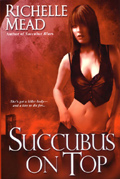
Book Two: Succubus on Top, AKA Succubus Nights (Depending which copy you pick up) - Georgina Kincaid Series - Richelle Mead - 2008

Love Sucks and Hurts, especially for Georgina, a succubus who has just got herself a new boyfriend in author Seth Mortensen. Georgina has to be so careful not to kiss him or get sexually involved, otherwise she will drain his life-force. Admittedly, the shape shifting and immortality perks are terrific, and yes, Georgina did choose to join the ranks of hell centuries ago. But it seems completely unfair that a she-demon whose purpose is seduction can't get hot and heavy with the one mortal who knows and accepts her for who she is.

It's not just her personal life that's in chaos.

Doug, Georgina's co-worker at a local bookstore, has been exhibiting bizarre behaviour, and Georgina suspects that something far more demonic than double espressos is at work.

She could use help finding out, but Bastien, an irresistibly charming incubus, and her best immortal friend, is preoccupied in the suburbs with corrupting an ultra-conservative talk radio star - and giving Georgina some highly distracting come-hither vibes.

If this wasn't trouble enough with the behaviour Doug is experiencing, others will soon start to have terrible consequences if Georgina, once again, can't save the day. For Georgina, who has just received a gold star certificate, this is a job she's getting used to.

Book 3 Succubus Dreams - Richelle Mead - 2008

[caption id="attachment_2740" align="alignright" width="99" caption="Dream on..."][/caption]

For some girls, especially Georgina, they just can't catch their breath, and today is one of those days; or should I say one of those books.

In Book three we are introduced to the not very nice Imp Niphon - he was the one that, way back, centuries and centuries ago, Georginia sold her soul to.

Imp has arrived in Seattle with a new succubus in tow, and a mission - or should I say a job - that Georgina, if she knows what is good for her, can't turn down! Georgina is to mentor and help break-in a new succubus, Tawny Johnson. Tawny, in Georgina's eyes, (and I agree) is a mega-slut, and Skank, with a capital S.

However, as always Georgina finds herself stuck in the middle of trouble, she has a Nyx after her - draining away her energy while she dreams weird dreams of her future, or a past that could have been.

Georgina’s home, due to Carter, the angel, has been invaded by a group of semi-ungrateful angels and, of course, Tawny and Niphon.

If this wasn't bad enough, Georgina has gotten her friend Doug's sister a job, and she and Seth have been getting more than your average cosy.

Can Georgina, with the help of friends, get out of this mess as usual, and find her Christmas/New Year spirit. And does this book signify the end of the Seth/Georgina odd no-sex relationship?


[caption id="" align="alignright" width="99" caption="Hot stuff..."][/caption]

Book 4: Succubus Heat - Richelle Mead - 2009

Georgina has been in a funk - stuck in a never-ending rut, and is really starting on a downer and is annoying all her immortal friends.

Made to go and see a therapist by her “John-Cusack-lookalike” boss Jerome - after separating from Writer boyfriend Seth – Georgina does the one thing Jerome tells her not to do. The one thing a succubus does best... You guessed it! Sleep with the poor guy.

Now Georgina has Jerome in an uproar, so Jerome has come up with a little plan to get Georgina out of his hair. Send her to Vancouver, Canada on a mission. She has to stop the so-called amateur Satanist group, "The Army of Darkness", from making fools of themselves. For anyone else this would be an easy task but, as we all know, trouble follows Georgina everywhere and she is about to find herself in the middle of a big Demon War.

When Jerome goes missing and the immortals lose their abilities, it is up to Georgina to put her human mind to work and, with the help of some friends, find out where Jerome is. Georgina restores peace and their abilities before all the immortals are stuck in a never-ending time warp.

Keep your eyes open as old characters re-appear and new ones appear, and watch out for book Five to be released - Succubus Shadows.

So next time you are browsing your shelves for a good series to pick up and read, and the supernatural paranormal romance is a favourite genre of yours, head over to the M’s and check out the books by Richelle Mead.

Other Series include: Vampire Academy (6 Books) and Dark Swan (2 Books)

Paula


Thank you for joining us at Wicked Writers, Paula...

David :)


Wednesday, June 16, 2010

Special X Thrillers

I met James Garcia Jr. on a vampire/horror writer's social network sponsored by Vamplit Publishing. His first published novel, Dance on Fire, revolves around the premise of a Christian vampire. Here's the short description about the book from the publisher's website:

Two Kingsburg police officers have been butchered in an attack as ferocious as it is mystifying. Now two detectives and their families are being drawn into a battle that threatens to destroy them and those around them. In a marriage of horror and Christian themes of good conquering evil and redemption, Dance on Fire is the fictional account of characters drawn into the fire by supernatural forces.

I'm pleased to have this talented writer blog with us on our weekly topic. Please read on to see who's work inspires this novelist to re-read books again and again.

.
“The body hung upside down from the ceiling by nails driven through both feet. The head was missing, the neck severed to expose vein and muscle, artery and bone in a circle of raw flesh. What was left of the man was still dressed in bright scarlet tunic of the Northwest Mounted Police, the arms with their sleeves decorated with gold braid, now dangling down toward the plank and sawdust floor.  A pool of blood as red as the tunic spread out beneath the corpse. There was blood dripping from the tips of the dead man’s fingers but the splash of each drop as it hit the pool was drowned out by the slow, incessant, monotonous thud of a drum beating overhead. The drumbeat came from up on the roof beyond the trapdoor in the ceiling.

“Thump…thump…thump…thump.”

Wicked Writers and Readers, it was with this beginning that my worship of Michael Slade began.

Okay, perhaps worship is a bit much.

I find it difficult to believe that very few have heard of Michael Slade. I cannot think of one friend or acquaintance in my forty-one years who has confessed to being a fan. Since I began blogging this past February I have not seen his name mentioned once, nor have I seen any of his novels listed in any “favorites” category. I don’t know whether I can do much to correct this grievous omission, but I aim to make one hell of a shot at it.

There have been thirteen Special X thrillers: Headhunter, Ghoul, Cutthroat, Ripper, Evil Eye, Primal Scream, Burnt Bones, Hangman, Death’s Door, Bed of Nails, Swastika, Kamikaze and Red Snow.

Well, did I pique you interest yet? Consider the following:
“Would make de Sade wince.” –Kirkus Reviews

“Will raise hackles, eyebrows, and blood pressure everywhere…Give you real shock value for the money…the most gruesome I have ever read.” –Robert Bloch, author of Psycho.

“Slade is warped and I love it! He builds suspense like a Chinese water torture.” – Bruce Dickinson of Iron Maiden.

How about now?

First of all, his name is not Michael Slade, but Jay Clarke. He has written with others, most notably his daughter Rebecca. He is a Vancouver-based trial lawyer, specializing in cases for the criminally insane. He writes about the Special X division of the Royal Canadian Mounted Police. It is dark material because it exists in the real world. Because of his profession, he has no doubt seen the worst that there is. Yet, his writing is not splatter-porn. It isn’t Marilyn Manson. It doesn’t exist to make you sick or to push your boundaries. He simply takes you on a roller-coaster ride that will at times quicken your pulse; at others cause you to add another light to the room, rather than continue reading him in the dark; he will most definitely force you to spend more time checking that noise that you just heard.

If you thought Michael Crichton’s bibliographies were extensive, then you haven’t seen anything yet. Slade’s are often five pages long. He is well-read and well-researched, using history, forensics and science, extensively. He alludes to the most infamous serial killers of our time as he paints his own brutal and diabolical fiends; killers who take no prisoners and very often take out major and minor characters alike.

Just as Crichton had us accepting that dinosaurs could be brought back to life through DNA, Slade will have you believing that Jack the Ripper has come back from the dead. Like Dan Brown, he’ll have you flipping pages and, in fact, entire chapters, regardless of the late hour. And unlike any other, I guarantee that you will come back for more.

I really cannot believe that more people do not know about his body of work.

Headhunter by Michael Slade literally changed my world and helped to set me on the path that stands before me today. I recently began re-reading it and I cannot wait until this post is published, so that I can get right back to it.

I hope you will join me.

Thanks so much for joining us this week, James. Your enthusiasm for this series is clear - and if I can get past all the blood and gore, while still being able to sleep at night, then I'll be reading it soon (but if not, don't hold it against me. I get scared easily!)

Please check out James on Facebook and stop by to see his work as well.

Wednesday, June 9, 2010

Q & A withKatrina Michaels

Today’s special guest is Katrina Michaels, author of Midnight Reflections. A mystery thriller involving werewolves, vampires, warlocks and…a serial  killer.

Basically, the story revolves around…well, maybe I’d better let you read Katrina’s synopsis:
Midnight Reflections introduces a society where vampires, werewolves, warlocks, and witches freely roam amongst the ordinary humans. One such human, Tara Daston, only wanted a fun night out dancing with her boyfriend. Getting killed was certainly the last thing she ever expected and waking up three days later as a vampire was the last thing she ever wanted. As Tara struggles with her death and new unlife, she also becomes involved in a hunt for a vicious serial killer. During her own investigation into the killings, she meets Tom Duncan, fellow vampire and lead agent of the Preternatural Investigation Agency, who is not at all amused at what he considers to be her interference. However, the serial killer soon takes notice of Tara and is intrigued, forcing her to work together with Tom and the rest of the agency to stop the murders.


Sounds intriguing, in the vein of Vampire Vacation and just about anything from L.A. Banks and Kim Harrison.

Fortunately, I was able to tear Katrina away from her book-supporting duties long enough for an interview. Please ignore the length of the session (that’s the journalist in me). Just read and enjoy.

An Interview with Katrina Michaels


Greg: How did you get interested in werewolves, vampires and other aspects of the supernatural?


Katrina: Well, I can’t actually pinpoint how my interest started. I’ve always been intrigued by fantasy and supernatural stories. When I was a kid, I loved the animated movie The Last Unicorn. I think my first vampire movie was The Lost Boys and I really became interested in the genre when I read the first Laurell K. Hamilton book. And, of course, there was Buffy the Vampire Slayer (TV show not the movie). I’m generally a fairly analytical person, so I think I love writing stories of magic and supernatural creatures to even myself out. We can’t be serious and logical all the time after all.

Greg: Will Midnight Reflections be the start of a series? If not, what are you currently working on?

Katrina: Yes, Midnight Reflections is the first in a series of five books. The second book -- Dead Awakening -- is currently with my editor and should be out in print next fall. However, I also have ideas for at least two other books, which might become series, outside of the Preternatural Investigation Agency series.

Greg: Sympathetic vampires seem to be the in-thing (particularly with Generations X & Y), what with Twilight, "Anita Blake," Vampire Academy, Underworld, etc...How do you horn your way into such a crowded market?

Katrina: It is becoming a crowded market so the way to set yourself apart is to try something new. Most of the books that involve vampires also deal primarily with angst and romance. Now I don’t mind either, but I like my books to also have humor, action and mystery and that is what I created. Unlike many of the novels out there, Midnight Reflections does not have any obvious romance. Yes, there are subtle hints of future romance, but nothing overt. And while Tara and Tom do have some angsty moments, they also smile and laugh and remember that life is not completely all about suffering.

My style of writing and storytelling is a bit different from what is already out there in the market, which I hope will appeal to people who are looking for something new or unique. I greatly enjoy criminologist shows (such as CSI and Criminal Minds) and books (James Patterson and Jeffrey Deaver). Which is why Midnight Reflections is more a murder mystery with supernatural characters than anything else.

Greg: How do you think vampires and werewolves fit into modern society? Why have they suddenly become acceptable and do you think we should keep at least a few bogeymen around?

Katrina: People are attracted to the dark and mysterious. In a world where science has explained many of our mysteries, we need a little fantasy. Exploring the world of vampires and werewolves allows us to indulge the dark side that exists in everyone.

To me, vampires have never been as scary as real people. It’s not the movies that involve people turning into monsters that stop me from turning out the light at night. No, it’s the movies about serial killers and stalkers that make me check my closets before going to bed. We still have plenty of bogeymen out there.

Greg: What was the hardest part about writing "Midnight Reflections"? What about the hardest part of getting it published?

Katrina: The hardest part about writing for me is that I don’t write in a linear fashion. I start to write Chapter One, but then I get a very clear idea of something that would happen near the end of the book and have to write that scene before I lose the inspiration. And then I come up with an idea that causes me to rewrite the few chapters that have already been written. Also, when I start writing, I have the general story in mind with some very clear scenes that I know need to happen, but the rest of the story develops only when I start writing. But in the end, it all comes together.

For publishing, it is the waiting. You send off to one of the few publishers that still accept unsolicited manuscripts and then have to wait around 3-6 months before hearing the response. And since you can really only submit to one publisher at a time, if you get rejected then you have to start over with a new publisher and wait some more.

Greg: Who inspires you to write?

Katrina: I don’t know if I can say that one particular person inspired me to write. I’ve always loved creating stories since I was in grade school. But I will say that I’ve been influenced by certain authors.

I’m an avid reader of many different genres. As I said, while I do enjoy books involving the supernatural, I think I have been more influenced by authors like Jeffrey Deaver and James Patterson. They both write fascinating mystery / thrillers that take the reader by surprise with sudden twists and leave you enthralled as the killer stalks his next unsuspecting prey. This is a genre that I love, but I also love creepy supernatural books and movies. When I started writing this book, the first question I asked myself was what if a vampire started hunting a serial killer, and the story progressed from there.

Greg: What was the last really good book about vampires, werewolves or other supernatural elements that you've read?

Katrina: Hmm, that’s a hard one. The book I’m reading now -- A Fistful of Charms by Kim Harrison -- is captivating, but I would say that the best I read recently was Nightlife by Rob Thurman. It’s an excellent urban fantasy with many different supernatural elements mixed together into a fascinating world.

Greg: What was the last book that really wasn't worth your time?

Katrina: That is a question I don’t think I can answer. I may not enjoy every book I’ve read, but I would never consider one not worth my time.

* * * * * * * * * * * *


Again, I want to thank Katrina Michaels for taking time out of her busy schedule to chat with Wicked Writers. I also want to let our faithful fans know that Midnight Reflections is available through Amazon.com, barnesandnoble.com, and bookdepository.com.

Friday, May 28, 2010

Vampires as an Academic Study?

Please welcome Bertena Varney to Wicked! She and I met this winter on Facebook and I've been amazed at the reviews and things she's been able to accomplish since I made her acquaintance. She loves everything vampires, a topic close to my own heart, and has made it a point to become educated on the lore and history surrounding them (much more so than I can claim, I just make stuff up). She writes reviews and opinions on her website, for the locals as Lexington's Vampire Examiner, as the Paranormal Literature Examiner, and for Associated Content.

Last January I found myself nearing completion of yet another college degree. I had already completed the Master’s that I wanted (Sociology and Criminology) but as a certified teacher in Kentucky it’s required that one must complete a Master’s in Education as well.

I complied and before the last semester I found that there were no more education, history, or sociology classes offered. My only choice was an independent concentration on a subject that would involve lots of writing. I knew one thing at the time—after all the boring papers in college — that I HATED to write. I also knew that I would have to ask a professor to do the independent study with me— something they do not get paid for. After a long story, I found one that agreed and instructed me to return the first week of class with my topic, theory, and academic resources.

I went home and thought about what do I like so much that I can spend a whole semester just studying it? I looked around my house and saw vampire movies, vampire books, vampire pictures, etc. So, I thought, what have I watched, read and enjoyed since I was five years old? What would be an enjoyable assignment that would make this writing assignment not so bad? The answer was clear- vampires! Vampires?

I began to clear my mind of all the negative thoughts that I had heard my entire life. I sat quietly and just let the ideas come in and as they did I wrote them down— Dark Shadows, Buffy, Vlad, Bram Stoker, etc.— and began to research what these names had in common. I found that they were part of a true academic study called Popular Culture. At that moment the light went on and I thought, “I will do an academic study on the vampire” …and of course I responded back to myself, “Yeah right! She’s really going to fall for that!”

I decided I was going to convince her by making a list of popular vampire books, movies, television shows, comics, and cartoons. I then took that list and began researching it with popular culture and came across hundreds of academic articles including one on the Whedon Studies Association. WSA is an academic association that studies all things Joss Whedon- including his two vampire shows- Buffy and Angel.

After that I found a professor at Ohio University, Dr. Anita Blessing, and a graduate student, Amanda Hobson, who claim to be “vampire experts” and have even taught classes and workshops around the country. I wrote to them about my fear of being taken seriously in the academic field and how I should address the topic. Dr. Blessing said that she had had the same situation and advised I should say I study the cultural effects of vampires in pop culture on the culture. She was, of course, correct.

When the first meeting with my professor came, I entered her office quite scared. I had everything that she asked plus the brochures of the academic studies around the country, Ms. Blessing’s emails, and a Pop Culture Association and WSA membership application. I fumbled through these and tried to explain to her my idea—and failed! She asked me to stop and she said, “Look at me like I am your friend and tell me what you are thinking.” I did what she suggested, tried again, and her reply was, “I've never heard of such a thing. But you have a passion for it, you know the subject, and that is what academic research is about—passion for a topic and sharing it and the new knowledge that you find with the world. So yes, you may make this part of your academic concentration in this program.” YES!

The result of my hard work was a paper entitled, “The Search for the Lure of the Vampire.” It is a sociological study on the following topics: The Use of Vampires as Religious Icons, The Use of Vampires as a Socialization Tool, and the Lure of the Dead Boyfriend, a study in the rise of vampire literature.

In the end I found that once I began writing about something that I enjoyed, I no longer hated writing. I actually enjoyed writing about something in which I was passionate. However, I also found that many people do not share the same view as I do. Many do not understand what I am doing is a true academic study of why vampires have entered our culture over and over again.

Now I am a writer for Examiner.com with the title Lexington Vampire Examiner, where I write about vampires in pop culture. I also speak at conferences such as the Sirens Conference and The Witching Hour and am currently organizing my own academic and fan conference- A Day of Mystical Blood Lust. It is a day of events about supernatural creatures such as vampires, werewolves, faeries, angels, etc which ends with a Halloween Ball.

So, remember that whether you make your interest a hobby or a study— it is yours to make it what you want it to be for yourself. Listen to your muse and write and study what you love.

You can also find Bertena on Twitter and you can reach her via email at: vampireprofessor@yahoo.com

Thank you so much for blogging with us here today, Bertena. I know whom I'll be calling when I have any questions about vampires! The day of events schedule in Lexington for Mystical Blood Lust sounds like a blast and if there is anyway I can swing coming you know I will!

In honor of our week on Muse and Inspiration we're running another contest. A 500 word flash-fiction piece inspired by the writing prompt:


An Unexpected Death


First prize will be having your entry critiqued by one member of the team,  posted here on Wicked for the world to enjoy, and the DVD collection of True Blood Season Two!  Second place will be a critique as well, a posting here on Wicked and a $10 gift certificate for the book of your choice at bookdepository.com


**Contest runs until June 6th so listen to your muse and get cracking!**

Wednesday, May 26, 2010

Muse and Inspiration - Do You have Any?

I'm pleased to introduce the multi-published Cheryl K. Tardif. Cheryl and I met in a huge national writing contest last fall. She was supportive and unfailingly polite to a veritable newbie like me, which was just golden during that hectic time. The more I learn about Cheryl - from her book marketing, her diverse writing abilities, reading her blog, to her books being studied in class - I'm simply astounded. I only hope that someday I can accomplish what this author has and I'm eternally grateful she liked my work enough to put her name out there supporting me.

As a writer, I find inspiration in everything I see, hear, touch, smell, taste and do, and I encourage other writers to look for signs of the muse. If you’ve ever met someone who has shared a part of their life with you and their tale has resulted in a thought of: “Wow, that would make a great book”, that’s your inner muse talking. Sometimes something you see--like two people having an argument in a restaurant--might trigger inspiration in the form of: “What if a wife is plotting to kill off her husband after a romantic dinner?” Okay, not everyone’s mind works that way, but mine sure does.

If I asked you to write down ten things you saw today, could you turn them into a story plot? If you’re an aspiring author, I bet you could. I know I could. If you told me about something that happened in your past, I know it would send my muse into overdrive. My massage therapist told me about a detour she took to a strange little town and the creepy hotel she visited. I’m now writing a suspense/horror novel about my version of what’s going on there. If I allowed her to, my muse would be constantly whispering novel plots in my ear. As it is, I can barely shut her up, so I keep files on strong ideas.

If I was to ever run out of plots--and I honestly can’t see that ever happening--I’d only have to listen to the evening news for five minutes to become inspired by a story idea. While most people dwell on the facts of what they hear, a writer’s mind ventures into What-if-land. What if the bank robber stole the money because someone is holding his family hostage? What if that car crash involved a famous actor who is being stalked by a delusional fan? What if that tornado was really a black hole and everyone was sent to an alternate universe? And that’s just the news!

As a child, I had a deep love for killer whales. Every time we went to the Vancouver Aquarium, I wanted to jump right in with Skana and swim with her. Today, I’d probably have second thoughts, but I still dream of swimming with orcas. This led to my critically acclaimed, bestselling novel Whale Song. As a teen, I was interested in the paranormal--ghosts, psychics, strange happenings. This led me to write the first in my paranormal suspense series, Divine Intervention, a novel about psychic government agents searching for serial killers. Back in 2004, my mother told me about a friend who wanted to go down some river where people kept disappearing. This led me to wonder where those people went, what happened to them, and my thriller The River was born.

Your muse is that inner voice that speaks to you in dreams or thoughts, that helps you see a potential plot, even in the simple things. Inspiration can be found anywhere, but the most important thing for a writer to know is this: Your muse will help you find inspiration, but only when your mind is open to the search.

Cheryl Kaye Tardif is an award-winning, bestselling Canadian author who writes suspense and some YA. “I kill people off for a living,” she likes to tell people. When she’s not plotting a character’s demise, Cheryl is delving into her romantic side as Cherish D’Angelo, her pseudonym for her new romantic suspense. Cherish’s debut romance, Lancelot’s Lady, will be released September 27th, 2010.

Thanks so much for blogging with us today here at Wicked, Cheryl! I wish you much success with your upcoming romance title and we look forward to having you blog with us again as the release date draws closer. Readers interested in learning more about Cheryl can find her on Twitter and Facebook. You can read an excerpt and buy her work at these locations online: Kobobooks, Smashwords, and Amazon.