Showing posts with label plot. Show all posts

Monday, April 25, 2011

Plotting Plots


Thanks to the A to Z Blogging Challenge, I find my topics repeating themselves. So, I hope you guys don't mind me recycling posts today. See, I just blogged about this topic on my personal blog, not realizing the same topic was on Wicked Writers. No harm done, though. Saves me time. :)

Enjoy.

* * * *

There is a formula for correct plot structure. It looks something like this:

  • Introduce characters.
  • Introduce story goal or theme.
  • Characters create a short-term goal as a means to accomplish the story goal.
  • The short-term goal is thwarted. Characters react to this then create a new short-term goal.
  • The new goal is also thwarted.
  • This repeats over and over until the climax is reached (by making the failure worse each time until the tension reaches a breaking point).
  • The characters try one more time. This time they beat the opposition.
  • The story goal and subplots are tied up. The End.

Relativity simple, right? It's a great way to outline a story. The trouble comes when it's obvious that you used a formula. And there are several authors out there who's writing is formulaic. I won't name them, but you can usually tell who they are because they come out with several books a year and they all sound alike. But, this is a great tool for beginners who may need a little guidance or practice in building a strong plot arch.

As for Scene Structure, remember this sequence: "Action, Emotion, Reaction, Decision."

Seriously, memorize it. I have it written down on a sticky-note and posted on my desk. Allow me to explain.

Action: Always start a scene with action. Remember the saying "actions speak louder than words"? It's true for your characters as well. Act first, explain later. Action is what moves your characters forward. Plot is what movies your characters forward. So, action equals plot.

Emotion: Your characters have to have some sort of feelings about the action that just happened. This is usually their first reaction and it's usually the wrong one. That doesn't mean it's wrong for the character or for the book. What I mean is that this is usually a negative emotion, such as anger, sadness, etc. that will make your character do something dumb out of spite. This is good. This is deep point of view and makes your characters real.

Reaction: This is when your characters start to think more clearly and re-asses what happened. They're more level-headed here.

Decision: Your characters make a decision about what to do next, which leads into the action beginning the next scene. The cycle starts over.

This lesson is a quick summary of a long version from the book "First Draft in 30 Days" by Karen S. Wiesner and is hands-down the most valuable book in my personal library.

Thursday, September 30, 2010

Pushing the Envelope

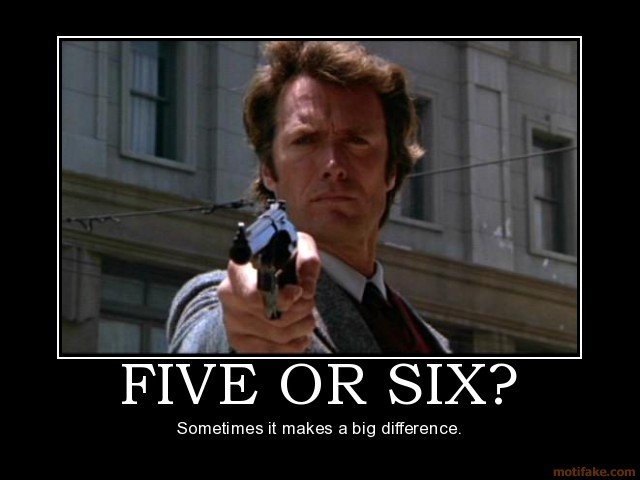
[caption id="attachment_3550" align="alignleft" width="300" caption="Dirty Harry and his loaded question."][/caption]This week’s prompt is: Pushing the Envelope. Therefore, the first question one must ask is: "Do I feel lucky?" Okay, that's really a bit of dialogue from the classic motion picture, Dirty Harry, but a very good point which we will get to. I mean, really, what does that mean, pushing the envelope? What envelope?

For me it means just the opposite of what I have been doing since this amazing turn of events began last year when I found that publisher. With regards to my writing, I haven’t been pushing anything, other than myself to do so much more. Yet, we're not discussing working hard, meeting impossible deadlines or making our presence felt to the masses. I believe that "pushing the envelope" refers to pushing past one's comfort zone. To move beyond self constructed barriers. To do what is not comfortable.

I am not a marketing guy, but I think I have been bright enough to know not to alienate potential buyers of my novel. Therefore, I have not mentioned in any short story, novel, post or article which side of the political fence I may or may not reside. I have stayed away from any and all incendiary topics. Not only this, but I have also attempted to shy away from small things which could also get feathers ruffled, such as what form of music I have little appreciation for, or which sports teams I follow. Some of these things probably sound rather trivial to some, and most certainly, some of these things will eventually be made known (Country Music; Dallas Cowboys and Chicago Cubs). My point is that in the beginning I wanted to try to be able to reach every facet of my potential audience.

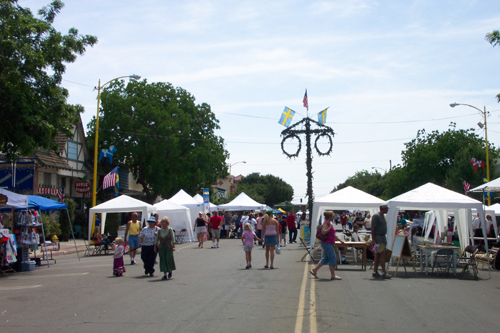
[caption id="attachment_3551" align="aligncenter" width="300" caption="Draper Street, Swedish Festival"][/caption]One example that I can give is The Kingsburg Swedish Festival. The city that I live in has Swedish roots. Therefore, our colors are Swedish; our buildings have a Swedish architecture; for all intents and purposes, we are a Swedish town. Once a year in May, we hold a festival which draws thousands. Years ago, the festival used to be held in our large park. Before and after our Saturday parade, people would head back to the park where the vendors and food booths were located. We had shade and comfortable grass to walk upon. Eventually, it was moved downtown to what we call our main street. Now we have to walk on cement and asphalt, and have little shade from the sun; but the consumers can walk amongst the shops and thus boost the downtown. Recently, there was a Facebook movement began which hoped to move the festival back to the park. However, since I am now a member of the Chamber of Commerce, you must now see that I declined the invitation to side with one side or the other. I think any reasonable person who has attended the festival would probably know which choice is best, but I am staying away from the subject.


Now, having said all of that, is this really what we mean? Or is it something more?

There is another way that one could push the envelope. My novel is a Christian/Horror crossover. It has a little bit of both and, I hope, is just the right combination to make the novel interesting, fresh and gripping. Now that it has been out for seven months, and I have begun to grow a small following across social networking sites as well as in my hometown, and the audience has begun to know what to expect from me, could it be time to push against their comfort zone? Do I now release a dark and pure horror novel where the devil seems to win more than he loses? Or do I release a purely Christian novel? How about Romance? I could do that, you know. I reach for the romantic comedy DVDs quicker than my wife does. Don’t think I couldn’t! Perhaps I could really shake things up by writing about the rape and murder a young girl much like The Lovely Bones.

What do you guys think? When might it be time to do such a thing? Too early and one might lose an audience before they have that trust factor where they’ll follow you anywhere; too late and they might feel abandoned. I was going to cite Stephen King, but because his writing is so prolific and his audience so varied that he probably did not notice the couple of times that I quit reading him. Of course, he knows that we sometimes come back.

[caption id="attachment_3552" align="alignleft" width="212" caption="See! I told you."][/caption]

Thursday, September 16, 2010

Outlining: A Personal Journey

[caption id="attachment_3437" align="alignleft" width="300" caption="Taken last winter with 100 other potential author photos. The beard did not last the spring."][/caption]

      To outline or not to outline; that is the question. At least that is one burning question this week at Wicked Writers, where we endeavor to discuss, convince or even lecture on the necessity of plotting one’s course when beginning that next bestseller. Some might suggest that it is in fact the most important writing one will ever do.

     As I contemplated this week's prompt, I was unsure just which side of the fence I was standing behind. I have written by simply sitting down and blazing ahead, come Hell or high water. More recently, I have written with more of a plan. It wasn't until I had written this post's rough draft that I came to fully realize just which side of the fence I should be standing behind. Walk with me, won't you...

     I might be a special case and I will leave that for you to decide just how special needs that might be. What I mean by this is, I have done quite a lot of writing where I have started madly typing away, allowing the visuals in my head to play out as if they were the scenes in a motion picture that had yet to be written down. A script in reverse, if you will. Regular readers of mine will recall that I have mentioned this before. In fact, my first novel was written just this way. It did take twenty years to write, so it would be extremely difficult for me to champion this method of writing. It took much editing and many rewrites to get it where it is now, and may be one of the reasons why it took so long. Perhaps if I would have mapped it out with an outline it might not have taken so long to complete. I have also written all of my short stories in this fashion, but the size and scope was so much easier to rein in, if and when things began to go astray.

     For my second novel I did map it out. I don’t know whether it was the greatest outline in the world since I had never tried writing a novel with one before. I think it did help me to map out the action beforehand and to narrow my focus. That novel only took eight months to write from beginning to end of second draft. My third novel in the series currently only exists as an outline. Yet, even now, as I contemplate working on that project this winter, I can hear the outline speaking to me. I grow excited just thinking about it, most likely since I don't have to do the heavy lifting now. I am confident that once I blow the dust off of that thing, the images will begin to play and the writing will be quite easy. Whether it is good or not remains to be seen!

     You will be visited by three ghosts... Okay, perhaps just one.

     Come just a little further please...

     I recall a painful writing experience that occurred in my youth. Today, not only does every home have a computer, but there is one in every other room. However, what you are about to see occurred back in the 1980's when there were only one or two computers on every block. You know, the dark ages! Anyway, my neighbors allowed me access to their pc for my writing. I spent many an afternoon there, but one particular evening I must have been late getting home and neglected to save my work. I recall leaving their home, feeling horrible as I walked back across the street. That night I spent hours jumping out of my bed as bits of action, dialogue, etc., came flooding back as I was attempting to go to sleep. Eventually, I got enough of it back, or at least enough to save the story. If I would have had an outline, it might have saved me from a lot of stress, unless of course I had neglected to save that, too.

     As you have taken this journey with me, you must realize, as I have, just how important outlines can be.  Mine are not great sketches of character or the latitude and longitude of every single subplot. They are only a few sentences that essentially script out where I need to be with each chapter. They still allow me the freedom to create, unshackled to strict rules, while helping me to focus on what should to be happening next. Perhaps more importantly than anything for me has been how helpful they have been with my pacing. Studying my outlines I have come to realize just what was needed and exactly when it was needed, much like a film director planning his shots by storyboard.

     If one would have asked me how much stock I put into outlining prior to this week, I might have said that I was not a believer. However, as you and I have found as we walked the terrain of this subject, I believe that I can be firmly counted among the converted. How about you? Are you reluctant to sit down and outline for fear that it zaps the creative process? Is it far too mundane a task? Are some of you other Wicked Writers out there believers in simply sketching your writing, and thus leaving plenty of opportunity for creativity or spontaneity? Do some of you actually prefer the shackles? (Poor attempt to entice comments?)

     The Wicked Writers Staff thank you for all of your comments this week and every week, and hope that you will keep them coming. We are reclining about Headquarters, snacking on Maple Bars and sipping coffee, eagerly awaiting more. Or is it just me?

     Oh, and thanks for taking the walk with me...

Wednesday, August 11, 2010

The Mandarin Segment...

Something completely different?

OK, so, out of all the elements that make up a good story – which would I tell a novice they should take the time to study up on? You’re asking me? Really?

English usage? Strike one – C.J. gone done that one – fair‘n’square…

Plausibility, or, if your name is Greg: Keeping it real… damn it, Greg! Strike two!

No, please… Sharon, must you? Strike three… Out? Failed on account of characters?

But, in (my) reality all of the above and more ARE required. Now that really IS a problem for the novice writer.  So let me cast my mind back to when I had a story idea for a novel. What pragmatic advice would have helped me with the daunting task ahead of me? In fact, what was the first thing I wanted to find out about that ACTUALLY got me through the process of getting the idea down on paper?

Well, if you will bear with me – perhaps even read a little “flash” of inspiration… then maybe, just maybe, I’ll tell you…


The Mandarin Segment...


“Bye, honey,” she said “...don’t forget to eat something. It’s breakfast time! There’s a bowl of fruit on the table.”

With that his wife disappeared from view, on her way to the beach – his young son skipping gaily in-hand.

The writer sat at the small desk of the hotel they had checked into early that morning. It was the start of his holiday, but he had made a commitment. This last project, then he would relax. He had promised. He’d promised himself, promised his wife and child. He was an honourable man; promises were that: responsibilities to be met.

Sweat poured from his brow as the heat of the rising tropic sun screamed in through the open window. The gentle sea-breeze offered no respite. The effects of a sleepless early morning flight crowded his thoughts. Inspiration, that ghost of fancy, slipped from his grasp – that drowning muse parted his metaphoric grip as he, the sole survivor in his boat of life, looked helplessly, listlessly on.

Where to start?  It was his first novel... the commitment made to himself...  an outline of the story! A plan! Yes, damn it, he’d already qualified himself as a writer – but this was different... a novel? Eighty thousand words, he told himself... over three hundred pages. The thought scared him. Where to start?

He stood; he sat; he fidgeted.

The mid-day sun rose to its zenith... then fell.

Hunger avoided him as a plague.

The disappearance of his muse had long ceased to be that faded ripple on the outgoing tide of his consciousness. Oh yes! ...he still had the idea ...that glimmer of story hope that teased him into continuing his purgatory existence. But ...eighty thousand words?

The deadline, the end of this day, loomed ominously. Soon, they would return: promises to fulfil.

He paced the room. Desperation rose as a geyser from the bottom of his soul. Bile kissed the back of his throat. Panic began to consume him.

His eyes, heavy in desperation, rolled downward. His glance set upon the bowl of fruit. Atop the bananas, apples and grapes stood a single mandarin. The small orange fruit melded with the colour of the now setting sun. The mandarin became one with nature, growing in stature as his vision occluded all else before him.

He stood, mesmerised by the immense vision of the mandarin that became the world before him.

He stooped forward. Reaching down with his left hand he picked the fruit from the bowl, surprised at its lightness, given the sense that it seemed, at that moment, to hold the source of all energy. The fruit became all.

Involuntarily, his right hand met his left, trapping the soft fruit between them. It radiated inspiration. It controlled his movements. He knew not why his thumb pierced the orange skin at that precise time. He knew not why the skin fell cleanly away as, caressed by his touch, the fruit rotated against the sharpness of his nail. He knew none of these things. He knew only that he now held the mandarin, its fleshy nakedness exposed. Its pithy segmentation beckoned him.

The fruit was whole, it invited him to enter... to consume, not be consumed, but where? Where to begin?

And then he knew. ...A plan!

He smiled. He would break his story into segments. Each segment would begin as almost uniform, manageable scenes. Pithy links would bring the segments together, to realise the whole – an arc of enlightenment; from beginning to end.

He slid his finger into the mandarin... and breathed life, wishing he’d been hungrier, earlier.

****


And my point?

Pace.

The challenge, should you accept it, is to pace the story idea across something like 300 pages without letting the reader down. The writer must carry the reader on a journey through place, time and characterization, using effective language, well written and grounded in a reality that allows the reader to relax when the going gets tough. To my mind this takes a plan. It is a big challenge and, for the novice, breaking the story into manageable scenes is a great place to start.

Happy writing, mon braves! (...with no apologies to Richard Condon) :)

Wednesday, March 31, 2010

10 Inspiring Places to Write

Is it really the last day of March, already?

As usual, I had a hard time deciding on a topic, so I did what any lazy writer would do. I looked for inspiration in other blogs and found it in a few posts on writing spaces. So I first have to give credit to Brock Henning over at Lifesummit in his post Where is Your Writing Abode? Make sure you drop by, because his post is linked to a couple other blogs with interesting reads on the subject. I'm also lovin' Where Stories are Made… over at Book Chick City. Every week, they bring in guest authors to describe their writing spaces.

I've decided to approach writing spaces a little different in this post. I've included places, past and present, where I've found the most inspiration to write. Here are the top ten:

#10 - The Usual Places: Where better to begin than with the usual places I drag my computer around the house every day? Like right now, I'm on the couch, surrounded by snoring beagles, writing today's post. Whenever I stop in mid-sentence or paragraph, searching in my mind for just the right words, I scratch the nearest tummy and the answers comes to me. They're like little genies. In addition, I have an office I don't use because the desk is an old roll top that's way too uncomfortable. Instead I opt for the dining room table if I feel like sitting in a chair.

#9 - On Public Transportation: Ten years ago I lived in Colorado Springs half the week and Aurora, Colorado half the week. While in Aurora, I rode the bus into Downtown Denver, where I worked at the time. The commute was about an hour each way, and I was never without a notebook. Every morning I blabbered in the journl, added to my list of story ideas and wrote half a novel before I stopped riding on that route. So public transportation is good for more than the environment.

#8 - On a Long Car Trip: So you're wondering, how is this different than #9? While on a long car trip to Southern Colorado or Rocky Mountain National Park, I can edit my ass off. On public transportation, there are far too many distractions from fellow commuters, and I can't edit without mostly silent surroundings.

#7 - At Chuckie Cheese: Any place there are large numbers of screaming children, my ears tune out and my imagination takes over. So when my sons reached the age they could take off unsupervised at places like Chuckie Cheese or small amusement parks, I'd hand them a cup full of tokens, open the old notebook and write a new short story or add to a novel. This worked for everyone. They played for hours and I never killed anyone else's kid.

#6 - In the Middle of Downward Dog: Yes, I know you're supposed to clear your thoughts while doing yoga, but I can only do that for maybe two minutes at a time. It does help clear my mind of the insignificant crap quite well. So if I'm distracted and can't work through a scene, by the time I’ve stretched for twenty minutes, I’ve usually got it all figured out.

#5 - From a Jail Cell: Well, not in reality. Whenever I can't seem to find peace and quiet anywhere, the loner in me dreams of writing from a jail cell in solitary confinement. No Internet, no planning dinner, no vacuuming, and no teenagers not doing their homework. Ahhhhh :-)

#4 - With My Left (Less Dominant) Hand: Every now and then, when I don't feel I'm quite capturing the personality of an antagonist, I pull out a notebook and tell the character to write through my left hand. Oh, and I write backwards because it's just easier with my less dominant hand. Five years or so ago, I actually picked up a book in a new age shop that discussed using this technique as therapy. Since most antagonists could use a good therapist, I decided to let my bad guys talk to me using this method. The results are both scary and amazing. Or, maybe I'm also in need of a good therapist.

#3 - While People Watching: This one includes writing just about anywhere: coffee shops, libraries, park benches. I think C.J. hit on this one a few weeks ago. What better inspiration for characters than watching real people interact. Need a description for your bitchy character? Coffee shops are a great place to find 'em. The wimpy guy who just missed the bus might work well as your next victim, eaten by a monster down a dark alley.

#2 - In Bed; In My Head:  Sometimes I wish I could turn a story off like I can turn off the television. I was up at 2:30 A.M. Tuesday morning because The Courier was playing the next part over and over in my head. If I haven't written anything new for a few days or can't work through a scene, I have no control over my thoughts. It's worse, at night, when there are no distractions. Good thing I'm a writer and not a serial murderer.

#1 - Walking the Dogs with a Hand Held Recorder: While I love a tranquil walk with the pups, they are beagles, and half our daily one-hour trek involves them sniffing for rabbits and me standing beside them thinking about story plots, character development and new ideas. So I can't leave the house without my hand held recorder. Last year, around this time, I wrote a novel in a month and most of it was written during our daily walks. Heck, I'm expecting to write most of the second Courier novel this way.

And so that it, folks, my favorite writing spaces. I'd love to hear about any of your out of the ordinary writing habits.